Wednesday, March 4, 2026
Fender Blues DeVille
Sunday, January 18, 2026
Supro 1695TJ Black Magick Combo
![]() |
| Supro Black Magick Combo. |
![]() |
| Jensen P12Q in the combo. |
This particular model, the 1695TJ, comes with a modern Jensen P12Q speaker, instead of the more common Eminence-made, Supro-labeled BD12 speaker. I wavered between the two models, but ultimately went with the Jensen-loaded model. I saw that the Sundragon Standard, the Jimmy Page-approved boutique recreation, also used a Jensen P12Q RI.
The P12Q is a bright speaker and balances the amp’s dark voicing. It is much brighter than my Weber 12A125A and A12Q speakers, my only other 12” American-style speaker references. The speaker is housed in a plywood cabinet, a nice surprise.
I thought that the Tone control’s most useful range was between 10:00 and 3:00 at cleaner settings. At 3:00, the Tone Control started to cut a significant amount of low end. I did think that cranking the Tone control’s most useful was necessary for certain thinner and gainy Led Zeppelin tones, like Communication Breakdown.
The amp has an input jack that links Inputs 1 and 2, to allow for channel blending and to achieve more gain beyond cranking a single channel. Each channel individually is clean when set at 2:00 and below.
Sunday, November 2, 2025
Mesa Boogie Rectifier Traditional 4x12
![]() |
| Mesa Traditional 4x12. |
I grabbed a reference-quality 4x12 cabinet for $600 from Main Drag Music. The cabinet is a Mesa Boogie Straight Traditional 4x12. While the cab is not the mythical Standard Oversized cab, the Traditional size does have its fans. The Traditional 4x12 apparently is more mid-focused and not as scooped sounding as the Oversized 4x12.
![]() |
| Mesa 4x12 opened up. |
The cabinet is loaded with four 8 ohm 70W Mesa OEM Vintage 30s produced in May 2001. The early 2000s are considered to be a desirable period for the V30 as a result of the ubiquitous use on rock and metal albums. Mesa Boogie let me know that the cabinet was shipped in April 2002.
![]() |
| T4335 Vintage 30 with 18EL date code. |
These Mesa Vintage 30s do indeed sound less harsh than my other Vintage 30s. For the past few years, I’ve moved around my 2011 MIC Vintage 30 from cabinet to cabinet to get it to sound like every other clip online. I can stop trying to approximate that sound with this Mesa cabinet now. Whatever the recipe may be (UK manufacturing differences, 8 ohm impedance, cabinet construction), it sounds good. I also have four speakers to choose from for variety in a recording context.
| Impedance Measurements Blue: Mesa Traditional 4x12 - V30 Teal: Suhr Reactive Load |
The cabinet sounds great with all of my high gain amps. The cabinet sounds balanced to me in the room. Listening to the speakers under a microphone confirms for me that there isn't a single sweet spot to a Vintage 30. Like with my other V30s, there are different zones to the speaker that sound best to my ears depending on the amp:
- Cap Center to Cap Edge: Mesa Rectifier Multi-Watt Vintage Mode, Crab Benzin VH3 Mode (Diezel VH4 sound), Mesa Badlander Crush Channel
- Cap Edge: Mesa Rectifier Multi-Watt Modern Mode, Mesa Badlander Crunch Channel
- Slightly Outside Cap Edge: Peavey 6505, Jet City JCA22H, Crab Marcus (Mesa Mark III sound)
Each V30 in this cabinet is slightly different in terms of frequency response. The most obvious difference seems to be in the 2-3k region, in which the two right speakers have more of. The lower left speaker seems to sound the most balanced for my tastes. I will share IRs of this cab to demonstrate the differences at some point.
I have recently gained a greater appreciation of the nuances between individual speakers within a cabinet. I have learned that there isn’t a monolithic sound for each speaker, rather subtle differences within a single model.
More to come.
Tuesday, October 28, 2025
Marshall 1960TV 4x12 Cabinet
![]() |
| Marshall 1960TV 4x12. |
![]() |
| 1960TV rear panel off. |
I was a bit surprised by some of the construction choices of the 1060TV. I was not expecting handles or the jack cup to be plastic. I’ve read mixed feedback concerning the long-term reliability of the handles. The long flathead screws used all over the cabinets were interesting. I understand the use of the partial thread screws for the back panel, but not for the attachment of the baffle to the front of the cabinet.
| Impedance Measurments Green: Marshall 1960TV - G12M25 Orange: EVH 5150III 4x12 - G12-EVH Blue: Suhr Reactive Load |
The voicing of the speakers is reminiscent of other reissue MIC 25W Greenbacks, with a roll off of high end. Pointing a Shure SM57 at the center of the cap is usable compared to the MIC reissue. This cab/speaker combination does not have the big lower mids of my 5150III 4x12 with 20W G12-EVH speakers. I treat the G12M25 and the G12-EVH speakers as distinct families of speakers. I think Plexi-level gain can sound a lot heavier with G12-EVH speakers, whereas the G12M25 maintains its classic rock voicing.
![]() |
| Celestion Greenback. |
I took off the back panel to take a look at the speakers. I confirmed that the Greenbacks were indeed made in the UK with a production date of October 28, 2020.
More to come.
Monday, September 22, 2025
EVH 5150III 4x12 Cabinet
I’ve been on the hunt for a quality 4x12 cabinet to pair with my tube heads. I considered a Mesa Standard 4x12, but couldn’t get past spending $1500+ on a new cabinet. I also wanted to use a 4x12 with my lower gain amps. I liked how the EVH 5150III 4x12 Dynacab pack from Fractal Audio sounded for both crunch and high gain, so I was open to the idea of acquiring the cabinet. The cabinet is supposed to be based on the construction of the classic Marshall 1960B 4x12 and is loaded with EVH-labeled Heritage Greenbacks.
![]() |
| 5150III Cabinet Front View |
A blem EVH 5150III 4x12 from Musician’s Friend appeared in my Google searches for 4x12 cabinets. The cabinet appeared new in the images with the exception of some scuffing on the metal corner protectors. At $500 off the new prices, I didn’t think I would see this price again.
![]() |
| Celestion G12-EVH speakers. |
The cabinet came single boxed with no padding other than a few pieces of cardboard at the base. The cab itself was in great condition, with the original tag and plastic over the logos still intact. Some minor bumps to the edges on the rear, but nothing that would lead me to return the cabinet. I opened up the cabinet to verify that the G12-EVH speakers were all accounted for. An inspection sticker was dated 09/05/2025, so still within a month of purchase. This cabinet most likely had a rough time during shipping and the original box was worn enough that it couldn’t be sold as new. The speaker connections are soldered, so I don’t think that I will be doing any speaker rolling in this cabinet.
![]() |
| Celestion G12-EVH T5600B code. |
My first impressions of the cab mirror the experiences of others. The cabinet is darker sounding and the big low end of the G12-EVH is somewhat loose. The darker Greenback flavor conplements bright Plexi and JCM800 sounds, both in the room and under a microphone. The cab sounds good with high gain as well. I really liked how the voicing worked with my Peavey 6505, Mesa Dual Rectifier Multi-Watt, and Crab Marcus. The G12-EVH works better with the 6505’s Crunch Channel than any of my other speakers. I thought the low end was a bit much with my Crab Benzin’s VH3 channel.
I wonder what about the combination of construction and speakers gives the cabinet such a big sound. All of the G12-EVH speakers consistently sound thicker than my G12M25 (Jet City 2x12) and G12M65 (Line 6 4x12).
Edit - 10-23-35 - I made some NAM Full Rig captures with my Plexi amp and the cabinet. The amp-cab combination has been great. The darker voicing of the cab smooths out the amp quite a bit. It sounds great at all gain ranges of a Plexi circuit. I thought the low end would be too much for Bass Spec sounds, but I was wrong.
More to come.
Saturday, September 20, 2025
Speaker Impedance Curves
I've been wondering about how the Suhr Reactive Load compares to my speaker cabs as an output presented to my tube amps.
![]() |
| Suhr Reactive Load (Green) vs V30/H75 in my Jet City 2x12 (Blue) |
I used a Dayton Audio DATS V3 to take some measurements to compare the impedance curves of various speaker configurations vs the Suhr Reactive Load. The Suhr Reactive Load is meant to mimic a Marshall 4x12 with Greenbacks as a reference. I was surprised how close its impedance curve compared to my Vintage 30/Creamback H75 combination (illustrated above).
I am looking into recording my tube amps with speaker loads when my playing environment is favorable to loud noise. The Suhr Reactive Load + IRs will continue to be tools that I utilize, but there is excitement in pushing air and moving microphones.
The accuracy of my lower gain amp DI captures should benefit from using complementary speaker loads. The Suhr’s 4x12 response adds some beef for rock tones, but it can be a bit much for some edge of breakup tones.
For those times that I cannot turn my amps up, my plan is to capture my amps in NAM with a speaker load.
NAM Speaker Load Captures vs Suhr Reactive Load Captures
https://www.tone3000.com/tones/vox-ac15c1-normal-channel-115dbu-ttsv10-input-31553
https://www.tone3000.com/tones/vox-ac15c1-top-boost-channel-115dbu-ttsv10-input-37813
NAM Full Rigs
https://www.tone3000.com/tones/full-rig-peavey-6505-1992-original-115dbu-ttsv10-36456
Varying speaker impedance curves is something I already explore in my Fractal FM3. Adding the contribution of my speakers to my digital tones via NAM is the next logical step.
Tuesday, August 5, 2025
Crab Guitar Effects Marcus
I decided to buy a Marcus 50W amp head from Crab Guitar Effects. It is inspired by the Mesa Boogie Mark IIC++/III series amps and is likely the most popular Crab model. The amp took about 11 weeks to build from my order in May 2025. The lead time increased by approximately 1 month since I last ordered a Benzin head. Shipping from Ukraine to the NE USA then took 9 days.
I am not particularly educated about Mark-series amps, but am excited to explore the tones in the amp. The cleaner mode is selected with the Drive push-button off, while the most common distorted lead and rhythm tones are achieved with the Drive engaged. I had to read the Mesa Mark IIC+ reissue manual several times to understand the functions of the switches.
I started off with the more distorted channel/mode. I turned the bass/middle off, treble/presence high, and adjusted the 5-band EQ. The graphic EQ affected the sound in a drastic way. I turned each band up/down for the most pleasing sound until I arrived at the setting shown in the photo. I arrived at the general V shape, except I preferred the 6500Hz slider around the middle.
There are many push-button switches in place of the push-pull pots of the Mesa amps. My initial preference for lead tones is Deep-On, Bright-Off, Boost-Off, Bass Shift-Off, and Treble Shift-On or Off depending on mood.
With the Drive off, I was able to dial in some nice clean tones.
I quickly put together a short mix using my Ibanez SZ520 into the Marcus. The speaker out was connected to my Suhr Reactive Load to get into my DAW. I used my 4x12 Vintage 30 IRs for the cab simulation.
![]() |
| Rear of the Marcus. |
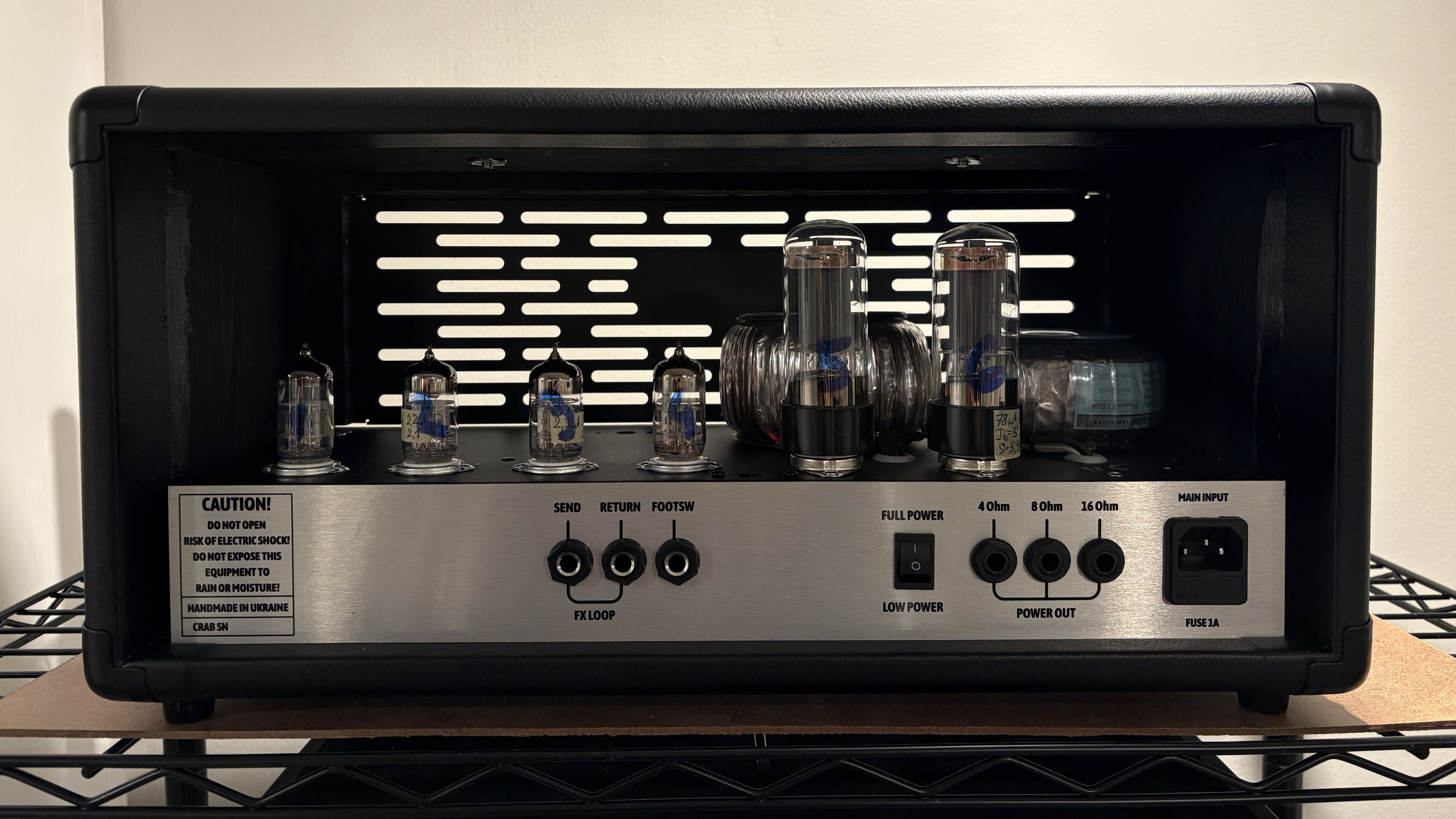
The rear panel has a C++/III switch, which I can only guess is similar to the Crunchberries amp. Otherwise, the rear panel features are the same as the other Crab amps (series effects loop, pentode/triode switch, foot switch input, 4/8/16 ohm jacks).
It is clearer on this Marcus what Crab Amps is providing on these amps for tubes. The preamp tubes are likely 6N2P, as the back panel is labeled ECC83/6N2P. The power tubes have visible 6N3C labels on them. These are apparently the Soviet-era equivalent of the 6L6GC power tube. My Crab Benzin did not have any markings to identify the tubes.
![]() |
| Old Crab Footswitch on the Left, New on the Right. |
A 2 button foot switch is provided to access the Drive and Boost front panel functions. The new footswitch has labels to better identify the functions.
Thursday, April 3, 2025
Mesa Boogie Rectifier Badlander 50 Combo
The Mesa Boogie Rectifier Badlander 50 Combo was featured as Musician’s Friend Stupid Deal of the Day at $1299. This price was better than used prices by several hundred dollars, so i had to jump on the deal. A total impulse buy, but perhaps one that is actually worth it.
The amp is said to be more on the Marshall-side of the tonal spectrum, like a Stiletto or Triple Crown rather than a Rectifier. When the Badlander was introduced in 2020, it was assumed that the amp would be voiced like the Vintage/Modern channels of the typical Rectifier series. The Creamback M65 that comes in the amp does give it a more British voice. The speaker is 8 ohms and sounds much smoother than my 16 ohm Creamback M65 that I’ve loaded in various cabs.
With some tweaking, I was able to dial in the Crunch mode to sound similar to Vintage mode on my Dual Rectifier Multi-Watt by dialing back the treble and presence. Cranking the gain on the Clean mode gets some dirt, like a different flavor of the Pushed mode of the Recto Multi-Watt’s Green Channel. It doesn’t quite get the same level of gain as my Plexi cranked, but I thought I was able to dial in a few similar tones.
For rock tones, I am generally happy with the Crunch channel’s gain around 2/3 of the way up. The Crunch channel can be boosted with the gain cranked for heavier tone. The Crush channel is a little more loose in the low end. The gain of the Crush channel can easily be cranked, but I prefer to back the gain off a bit if I am boosting the input.
The combo itself is compact. My Vox AC15 combo and Eminence 1x12 Extension Cab are wider than the Badlander 50. The omission of diamond plate makes this Badlander look more like a low gain boutique combo.
I posted some captures on TONE3000 of the amp. I used some synced DI and video clips to make a short video demonstrating some of the tones of the amp.
To be continued.
Monday, March 24, 2025
Guitar Pics
Crab Guitar Effects Benzin Head (Inspired by Diezel VH4)
My order of the Benzin 50W head, inspired by the Diezel VH4, is making its way from Ukraine to the US. I contacted Crab Guitar Effects through FB Messenger to put the order in. My amp was shipped a little over a month after I put my order in.
Edit - 4/8/25 - The Benzin has arrived. The amp was well packed, with styrofoam on all 6 sides and several layers of bubble wrap. The box got to me with minimal damage as it passed through multiple countries.
Here are some the features:
- 4 preamp tubes instead/ 2 power tubes
- Toroidal power and output transformers
- 50W output
- 2 sets of EQ: VH1/VH2 and VH3/VH4
- Footswitchable between VH1/VH2 and VH3/VH4
- Tone Shift to take out lower mid frequencies
- 1 serial effects loop
I wanted to get use out of all four channels of this amp.
- VH1 - I like this channel the least. I’ve been spoiled by the cleans on the Dual Rectifier Multi-Watt and Rectifier Badlander. Whereas the Recto Multi-Watt’s clean seems to be perfectly matched with V30s, the Benzin’s clean sounds a bit honky through the same speaker.
- VH2 - I was hoping to get JCM800-type tones out of this channel, and it does a great impersonation. Setting all of the tone knobs around 12:00 with the gain past 1:00 sounds very Marshall-like, especially through Greenbacks.
- VH3 - This is the sound that everyone associates with the Diezel VH4. This channel sounds like all of the clips that I’ve been hearing online. The low end is big sounding. The hope for a thick high gain voicing was main reason why I went with the Benzin over the Mesa Mark-inspired Marcus model. I came across some marked settings from Adam Jones. He apparently turns the Treble (4:00) and Mids (Maxed) up very high.
- VH4 - This is a gainer and more compressed version of VH3. The level of gain seems on pair with the 5150/6505 Lead Channel. I don’t think I would deviate from setting the gain between 9:00 and 11:00.
![]() |
| Crab Benzin front. |
![]() |
| Crab Benzin rear. |
![]() |
| The Benzin is compact in relation to a typical head. |
![]() |
| Benzin Guts. |
![]() |
| Benzin preamp tube wiring. |
![]() |
| Benzin on. |
Friday, March 21, 2025
DIYRE Colour Palette
I bought a DIYRE Colour Palette MkII while it was on sale at $120, right before the price increase to $200. It is a vehicle to use up to 3 Colour modules, modular audio circuits for an already modular 500-series format. I put off the build for about a year, but couldn’t justify an entire project sitting on my workbench any longer.
Each bypassable Colour module has a front panel trim/drive knob with a bypass button, with an overall master bypass button at the bottom. At the outset, I was planning on buying the Louder Than Liftoff Implode (1176 Rev F), Avenson MN-50 Smash (Fostex MN-50), and Tonecraft Audio Toneloc (Shure Level-Loc) compressor modules. At this time, I may skip the Toneloc since Shure has partnered with Korneff Audio and Black Lion Audio for the new plugin and hardware versions of the circuit. I am planning on going with the Louder Than Liftoff Pentode Mk2 module, a miniature tube saturation circuit.
![]() |
| Colour Palette with Louder Than Liftoff Implode. |
The build came together very quickly over 2 nights because of the relatively low parts count and spacious PCB. Like the DIYRE EQP5 I previously built, PCB solder pads were generously spaced. It was easy to get the main PCB to line up with the daughter board. I had an easy time fitting and aligning the faceplate to the rest of the assembly. Without any modules, I could not test the functionality of the unit when engaged. I learned that the LEDs only light up with modules installed, and the color of the illumination is based on the module. I had to get at least 1 module to see if the Colour Palette was properly working.
![]() |
| Colour Palette mounted in 500 rack for initial testing. |
I started off with a Louder Than Liftoff Implode compressor module. A jumper sets normal and high level of thresholds for the input section of the compressor, which doesn’t seem to be offered on earlier versions. Attack and release controls are set by trimpots, and are configured to Dr. Pepper settings at 10:00 and 2:00 respectively.
A pair of jumpers sets ratio for either 4:1 or All Buttons In mode, although I will likely leave the module at 4:1. The Colour format does not provide visual feedback for gain reduction of the input. I fed some sine tones into the unit to get a feel for the amount of output gain reduction at different trim/drive knob settings.
More to come.
Sunday, February 9, 2025
Line 6 Spider Valve 4x12 Cabinet
I saw a Line 6 Spider Valve priced very low around $200 and took the gamble to see if it was loaded with Celestion Vintage 30s. It unfortunately was previously raided and replaced with SLM Electronics speakers. I was disappointed, but decided to keep it once I saw the plywood construction.
I decided that I could load the cab up with a bunch of my Celestion speakers, some that had been collecting dust. I could have access to all of my Celestions ready for recording.
I decided to install my Celestion G12M65 (upper left), Vintage 30 (lower left), V-Type (upper right), and G12T75 (lower right). I may eventually move the Classic Lead 80 into the cabinet over the V-Type.
It may be detrimental to the overall tone with such a drastic mix of speakers, but I am still approaching cabs with cheapness. I am primarily close micing my cabs and will put up with the phase cancellation discrepancies for now.
![]() |
| Speakers mounted. |
The cabinet was a little beat up, but the construction appeared to be solid. The overall enclosure is constructed from 1/2” plywood. The baffle and bracing is also plywood.
The grill cloth is rather thick, so it was a bit difficult to locate the center of the speaker to record. It took a bit of measuring to figure out exactly where the speakers were located. The centers of the speakers are horizontally 6.5” off from the inner edge of the front frame. The centers of the top and bottom speakers are 6.625” and 6.25” off the inner front frame vertically. These measurements will help me recall microphone positions and methodically shoot IRs.
The G12M65 Creamback is a new speaker addition to my small Celestion collection. It is very reminiscent of the Greenback that I have. I think my G12M25 and G12M65 would sound very similar under the same conditions.
More to come.
Wednesday, January 22, 2025
Mesa Boogie Dual Rectifier Multi-Watt
My interest in acquiring a Mesa Boogie Dual Rectifier grew as I revisited the popular rock music of the 1990s and 2000s. It was a staple in all of the rock concerts that I went to as a kid in the early 2000s: in arenas, in tiny clubs, and on the Warped Tour. After going through all of the punk, emo, nu-metal, and metal albums that were recorded with Rectifiers, I knew that I wanted to have the amp.
With the new 90s Dual Rectifier being released, there were rumblings that the Multi-Watt version would be discontinued. I had been reading up on the Multi-Watt version for some time, but wasn’t enamored with its $2700 new price. I heard about its Lonestar-inspired clean channel, and it’s improved dirty voicings through many different discussion boards and demo videos.
A used Multi-Watt came up on the Guitar Center site at a good price via a tip on a forum and I jumped on it. The amp was just labeled as a regular Dual Rectifier. The tiny details such as the “100W Head” vs the “Solo Head” logo and the wattage switches on front panel required some zooming to discern. Once I received, I saw that the chassis was dated December 2010, so it is an early example of the amp’s run. The previous user had installed STR447 EL34 tubes in the amp.
![]() |
| Mesa Boogie Dual Rectifier Multi-Watt |
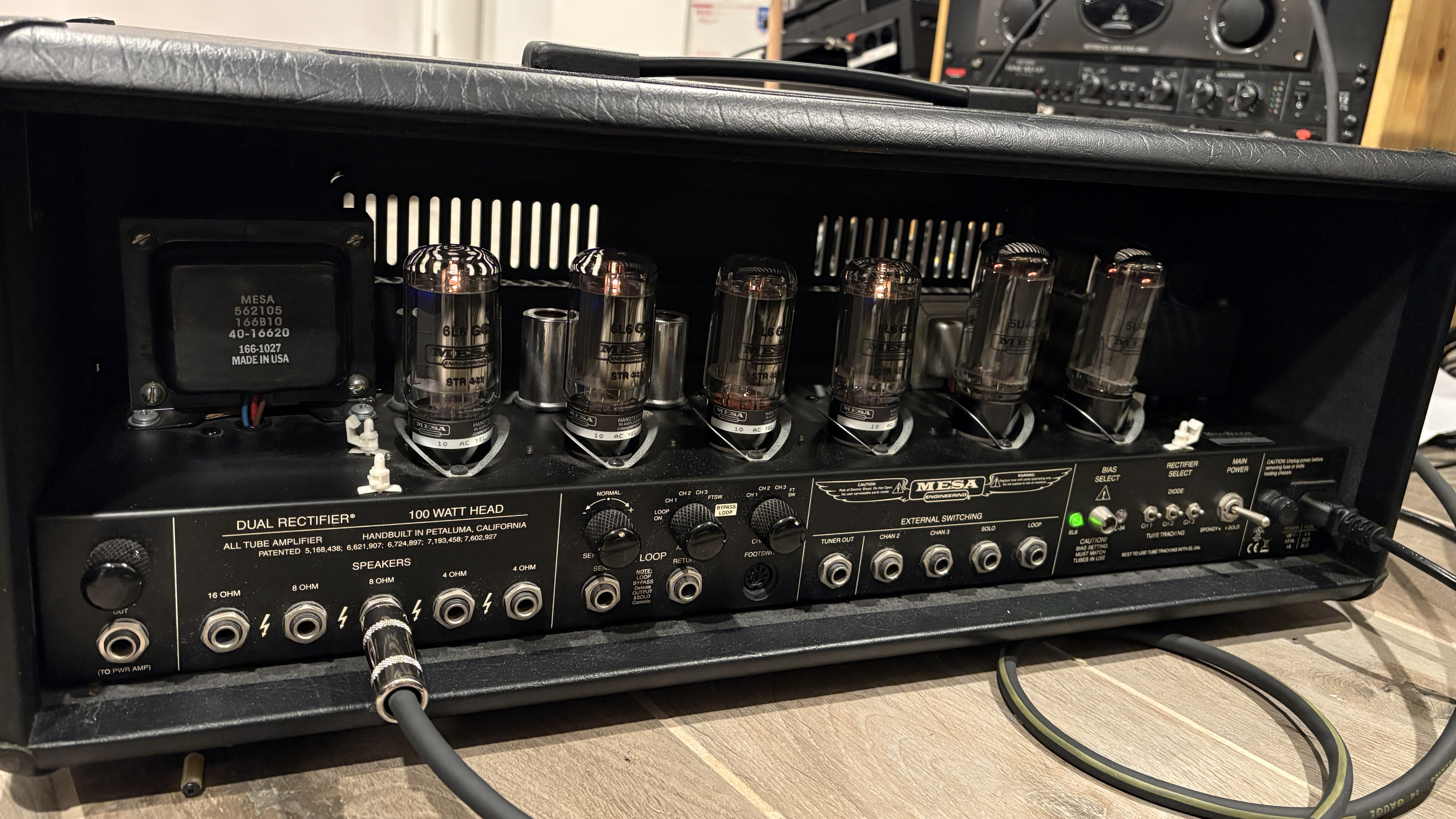
Disappointingly the amp did not power on when I received it. I replaced the bad 4A fuse, but the new fuse still blew with the with a subsequent power on/standby off. This behavior hinted that the rectifier tubes were a problem. I wanted to see if I could get it working again before resorting to returning the amp. I inspected the rectifier tubes and noticed that one had a part that was rattling around. Indeed, one of the 5U4 tubes was bad and was likely causing the amp to shut down. I didn’t want to take any more chances on the tubes.
I looked at a typical 3-Channel Rectifier schematic and noticed that the rectifier tubes were still in the circuit in diode mode. The screen grid resistors were all measuring 1kohm while the amp was off. The resistors looked like they were in good shape, along with the rest of the PCB. I decided to change out all the tubes in the power section, not knowing how old the tubes were.
![]() |
| Dual Rectifier with all tubes functioning. |
I put in new STR441 6L6 power tubes and 5U4GB rectifier tubes along with a new fuse. The amp powered up successfully in Bold Mode with the Diode Rectifier selected for all 3 channels.
I am still learning the nuances of the tone controls of the amp. I have mainly stayed in Channel 3 Red, switching between Vintage and Modern modes. Turning on Vintage mode and palm muting a Les Paul immediately reminded me of the sound on Ocean Avenue by Yellowcard. It was fairly effortless to find a sound reminiscent of the intro of The Hell Song by Sum 41.
Modern mode adds a large volume boost and the ubiquitous scooped nu-metal voicing of the late 90s. I needed to dial the Bass control back considerably below 11:00 to control the amp in Modern Mode. My Treble, Middle, and Presence settings have hovered around 12:00 in most cases. The EQ seems very touchy, as turns of 0:30 in o’clock settings seem to have big changes. On both channels, I prefer the amp’s Gain control to be in the 12:30 to 2:00 range on the Vintage and Modern modes.
I’ve spent some time with the Clean Mode of the Green Channel. Its relation with the Lonestar circuit is a major reason why I wanted to go with a Multi-Watt Dual Recto over a Solo Head. The Clean Mode stays clean for most of the gain range with my lower output pickups, so I tend to keep the gain control around 12:00. I like chow cleans come through my V30 speaker best. I’ve got no real amp counterpart for a Blackface clean sound, but the cleans on this Rectifier are good enough for me at this time.
I was surprised how much I liked the Pushed mode of the Green Channel with single coils. The Pushed mode can get a crunch sound that sounds like an entirely different amp. The sounds are slightly broken up at low gain settings (<11:00) and work well with neckups. Medium settings are crunchy, and outright distorted at the top of the dial. I prefer the bridge pickup at these higher gain levels.
I made a short clip of the Red-Modern and Orange-Modes at low volumes, linked below:
More to come.
Friday, December 13, 2024
Some Old Pedal Gutshots
Thursday, December 12, 2024
Studio Furniture: RAB LS840 Desk and Auray ERS-12U
RAB Audio LS840 Desk
I revisited my recording room’s layout to improve on my efficiency. I wanted to get as my outboard gear in front of me and ready to be patched in to use. I’ve had my my preamps and buss compressor patched in for the most part, but could not integrate my 500-series rack efficiently.
I thought about building my own desk, but decided to an off the shelf solution. I wanted to go with a smaller desk to avoid the temptation of leaving junk on the tabletop. I went with the RAB LS840 because it was narrower than the typical 48” desk. Most MDF desks at this price range offer 6RU, but the RAB had 8. I needed enough space to get my 500 series rack, Chameleon Labs 7603 pre/EQ, Audioscape Bus Comp, and Klark Teknik 1176-KT directly in front of me.
![]() |
| Front view. |
The build was straightforward for the most part. The unboxing and assembly video provided by RAB Audio’s YouTube channel was a helpful resource. All of the pieces lined up easily, much better than some other flat pack furniture that I’ve built in the past. Most pieces were secured with hex head screws.
The keyboard tray was a disappointment for me. The black screws for the tray’s components were difficult to tighten by hand, and I gave up on fully tightening the screws. The 32” width keyboard tray barely fit my M-Audio Keystation 49 II keyboard. The volume slider rubs against the bottom of the table a bit.
![]() |
| Tight fit for M-Audio Keystation 49 II. |
I was finding the 8in/8out limiting on my UR824 interface, so I decided that I will chain my preamps with EQs and compressors.
I’ve initially wired up a UR824 line output into the 1176-KT, followed by the 7603 Line Input back into the UR824 to use as a Comp-EQ hardware insert. It was immediately obvious how much more useful it was to have the controls directly in front of me rather than off to the side.
![]() |
| Desk rack - left side. |
I plan on having the following inserts set up:
- Klark Teknik 1176-KT > Chameleon Labs 7603
- 2x CAPI VP28 > Audioscape Bus Comp
- Stam SA73 > Hairball FET500 Rev D > CAPI LC25
![]() |
| JBL LSR305 Left 1/24 Octave Smoothing 30Hz - 20kHz |
![]() |
| JBL LSR305 Right 1/24 Octave Smoothing 30Hz - 20kHz |
![]() |
| JBL LSR305 Left 1/3 Octave Smoothing 30Hz - 20kHz |
![]() |
| JBL LSR305 Right 1/3 Octave Smoothing 30Hz - 20kHz |
![]() |
| JBL LSR305 Left 1/24 Octave Smoothing 35Hz - 400Hz |
![]() |
| JBL LSR305 Left Spectrogram |
![]() |
| JBL LSR305 Right Spectrogram |