I bought a Weber 12A125A speaker in my chase for the ideal 5E3 tone. I originally bought a Speed Shop A12Q for Tweed tones, but it turned out to be based on an early 60s speaker. Many forum posts for the A12Q remark that it is basically a Weber 12A125S, a speaker that is an Oxford replacement. A12Q did get convincing Neil Young tones, and is likely why the speaker is popular with 5E3 players. Neil Young uses a C12N speaker with his Tweed Deluxe, so the A12Q would be closer to being period correct for that sound. The top end was a little too smooth for me.
The 12A125A is the speaker I should’ve bought in the first place. It reminds me of a thicker version of the P12Q that is in the Redwirez impulse response library, which was my reference. The bright top end works well with the dark 5E3 tone.
I can see why 5E3 user may prefer the in-room tone of the A12Q, but the 12A125A’s recorded tone is exactly what I was looking for. My experience with micing the speaker so far is that I have to back the microphone off an inch more than I would with a Celestion-style speaker. When using ribbon microphones, I have to back off to about 6” off the grille to get the low end where I want it. The sweet spot for me is typically somewhere within the dust cap.
Weber Ceramic Silver Bell 30W
The Silver Bell was a B-Stock purchase from Weber based on my positive experience with the Ceramic Blue Dog. The Silver Bell is a take on the Celestion silver Alnico speakers used in early Marshalls. The speaker does remind me of a brighter Greenback when recorded, but the sweet spot is wider on the Silver Bell. With the Greenback, my preferred tones are around the dust cap-come junction, while I like the middle of the cone with the Silver Bell. When I was initially hunting for sweet spots, I was expecting yo find it closer to the center. I didn’t immediately gel with the speaker. However, spending more time to find balanced mic positions was a rewarding exercise. The Silver Bell works with every type of low gain front end that I’ve tried: Tweed, Voxy, Plexi.
Edit - 12/4/24 - I've posted the full extent of the impulse response capture of the 12A125A and the Silver Bell.
I find that almost all the mic positions could be useful with the Silver Bell. The IRs towards the cone, up to about 4.5" off the cap are probably at the limit of what I like in terms of high end rolloff.
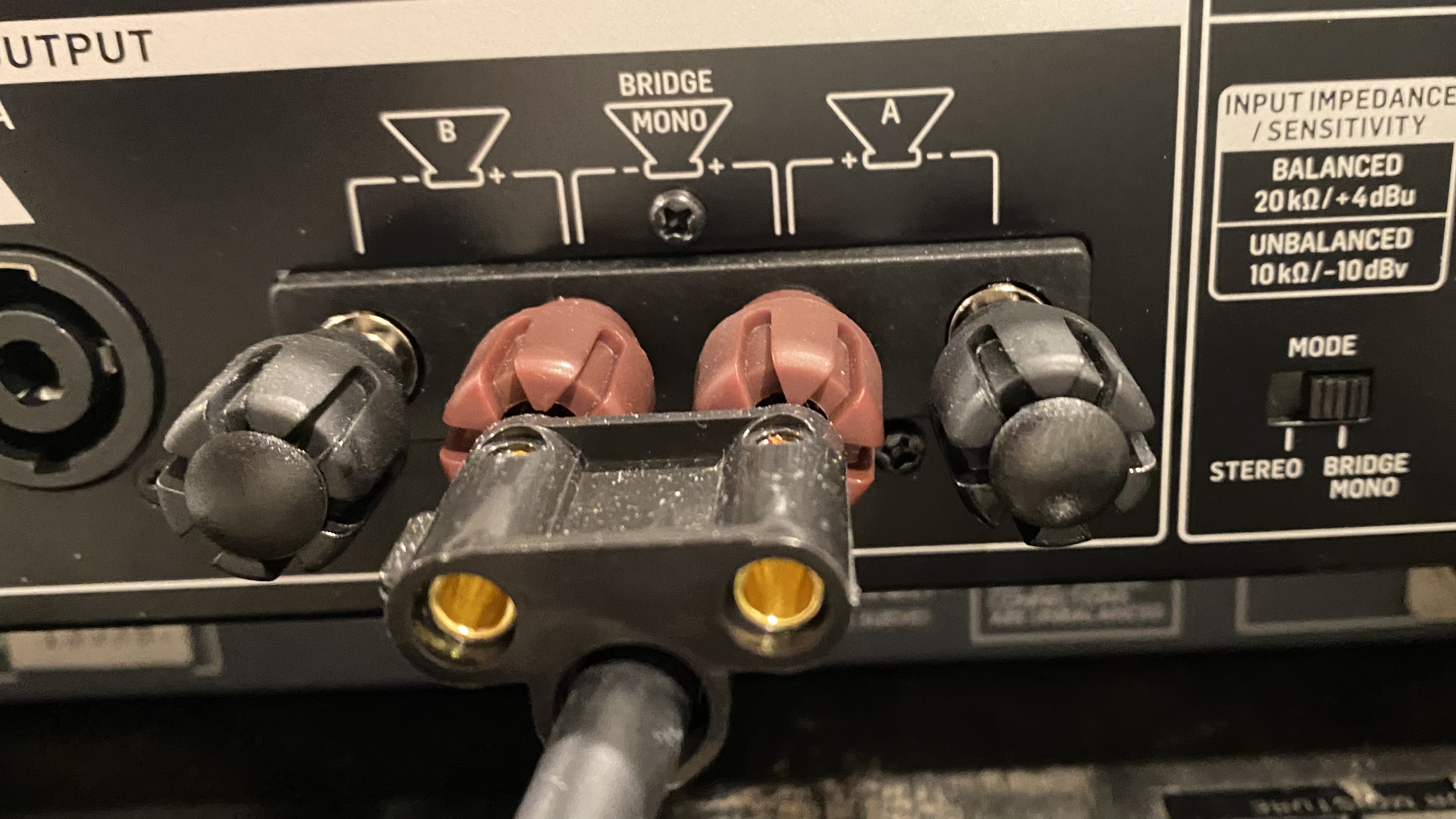
I bought a Behringer A800 power amp to power a pair of Realistic Minimus 7 speakers as a secondary monitor reference. At $200, it was cheaper than most new budget stereo rackmount power amps. An Audio Science Review of the A800 had encouraging measurements of frequency response, good enough for my monitoring purposes. I am monitoring at fairly low volumes, so I am barely cracking the dials and not pushing this power amp to its limits. The Minimus 7 and A800 combination are a good alternative reference to my JBL LSR305. The mids on the Minimus 7 are very noticeable, making it apparent when snares or guitar volumes are unbalanced. Yet the sound is not as lo-fi as an Avantone Mixcube; listening experience is still pleasing.
Running the A800 in Bridge Mono for guitar amp.
I tried using it as a mono power amp to make some guitar cabinet impulse responses. Coupled with a Chameleon Labs 7603 microphone preamp, I was able to get finally capture IRs that had a sufficient low end to my liking. I didn’t know how to accurately dial in my Seymour Duncan Powerstage 170 to be flat response in the low end for this application.
I've started reshooting my cab IRs. I started with my cabs with the Greenback, Creamback G12H75, Vintage 30, Weber Blue Dog, Jensen P10R. I plan on streamlining the mic selection to a SM57 with Crimson Orange handle, Beyerdynamic M160, Beyerdynamic M201, Beesneez BU87I C, and Sennheiser E906.
After some deliberation, I ordered a Speed Shop A12Q AlNiCo speaker to use with my 5E3 head. I was deciding between the Weber 12A125A and the Speed Shop A12Q for a while. The A12Q is a 20W Weber speaker built to Speed Shop’s specifications. It’s described as an idealized Jensen P12Q sound, supposedly with less highs than the 12A125A.
The positive reviews of the Speed Shop speaker on various forums led me to purchasing one. The price difference between the speakers was negligible. The speaker is still within the 12A125 family, so I ended up supporting both companies.
Weber identification sticker for A12Q.
It took exactly 2 weeks to take delivery of the speaker. The speaker’s build date was a week after my order went in, earlier than the quoted build date.
Speaker mounted in cabinet with grill removed.
I put the speaker in an unloaded Tech 21 1x12 cabinet that I got directly from Tech 21 for $57, including shipping. The cabinet is used interchangeably for the Tech 21 Trademark 60 and Power Engine 60 amps. Although the whole cabinet might be MDF, the Trademark series seems to be respectable enough from a tonal standpoint. I had to buy some 10-32 x 1 1/4” bolts to mount the speaker. It didn’t come with any speaker wire, so I bought a Fender internal combo speaker cable to wire up the speaker. I spent about $230 for the whole cabinet assembly, so I’m not concerned about getting a 100% authentic pine cabinet Tweed Deluxe experience. I do want to experience the 5E3 circuit through a Jensen-voiced 12” speaker rather than a Celestion.
Less than ideal speaker cable mounting.
I was able to use the power cord holder to secure the speaker cable’s make TS jack. I am connecting to an external speaker cable using a female to female 1/4” coupler. The speaker cable termination isn’t the most elegant installation, but I don’t want to sink any more money into the project.
A12Q speaker in Tech 21 1x12 cabinet.
I am liking how the speaker sounds in the room with the 5E3. I am of course taking impulse responses of the speaker cabinet to learn more about how my modelers and amps sound through the speaker at different mic positions. My initial observations from listening to the speaker are that there are more low mids and less highs than I expected. I am moving my dynamic mics back about an inch off the grill due to the proximity effect. The captures of mics close to the center of the dust cap are very useable.
While my focus is on getting tones with the 5E3 pairing, I may have stumbled upon some good sounds with my 5F1/5F2A amp. I ran some WAVs of the loaded down amp through IRs and really liked the tones in isolation.
Edit - 1/13/25 - I hadn’t been getting along with the speaker as well as I had hoped in the Tech 21 Cabinet. The tone seemed to be too focused in the lows and mids. It prompted me to buy a Weber 12A125A to chase the ideal 5E3 tone. Over the past few months, I’ve paid a little more attention to matching speakers and cabinets. I first moved the 12A125A into my Eminence XTC112-BT cabinet, and shot IRs with my mic collection.
I have moved onto the A12Q and have a much better appreciation for the speaker now. It now sounds like the 12A125A with a bigger low end and less of a 5k spike. The honky mids are gone and the speaker is much more usable.
I have been reshooting some more impulse responses of my speakers, knowing that I will have to put most of my gear into storage in June. The links on the download page are always updated to the latest attempts.
For my remaining immediate projects, I decided to stick with the following microphones:
Shure SM57
Beyerdynamic M201TG
Sennheiser E906
Oktava MK-012
Beesneez Lulu FET
Beesneez BU87I C
Cabs finished so far:
Jet City 2x12 - Celestion Greenback
Jet City 2x12 - Celestion V-Type
Eminence 1x12 - Weber Ceramic Blue Dog
Eminence 2x12 - Classic Lead 80
Eminence 2x12 - Vintage 30
Tech 21 1x12 - Speed Shop A12Q
Roland 1x10 - Jensen C10Q
Roland 1x10 - Jensen C10R
Cabs I can hopefully finish:
Pro Junior IV 1x10 - Jensen P10R
Roland 1x10 - Eminence GA10-SC64
Vox Pathfinder 1x10 - Vox Bulldog
I have been enjoying mixing my latest Celestion IRs in Ignite Libra from STL Tones. It is satisfying to blend through my set of speakers to come up with my own tones.
I initially bought the Eminence XTC112-BT cabinet in September 2020, under the impression that there was a small number of cabinets still in stock. However, the cabinet was backordered until early February 2021.
The construction is similar to the 2x12 version that I previously bought. The cabinet is made out of 3/4" plywood, with dimensions of 22.8"L x 11.4"W x 16.6"H. It is the same depth as the XTC212-BT. The front grill is removable to front load a speaker.
Front of unloaded cabinet.
Grille taken off.
Rear of cabinet with removeable back.
Weber Ceramic Blue Dog
I bought a used Weber 30W 8ohm Ceramic Blue Dog, with pre-Rola doping, to install into the Eminence cabinet. The Reverb listing claimed that the speaker wasn’t broken in with only 6-10 hours of playing time, despite being over 10 years old.
Weber Specification Sticker.
Weber Ceramic Blue Dog.
Loaded cabinet with back removed.
I intend to use the 1x12 cabinet with the adjustable back off for lower gain and clean sounds reminiscent of the Celestion Alnico Blue. The cabinet ($150 + $40 shipping) and speaker (~$100) came out to just under $300.
Cabinet with Warm Audio WA47JR in front of the Ceramic Blue Dog speaker.
I think the sound is similar to other Celestion Alnico Blue speakers in IR form, although there is a slight fuzziness in the sustain. At about half the price of pretty much all Alnico 12" speakers, I am happy with that compromise.
I am very happy with how these impulses turned out. I have been able to learn a lot about mic positioning of the speaker by making these impulses. It's also helped me figure out how to emulate specific album tones done with Vox amps. See my post on the NAM capture of my Vox AC15C1 amplifier.
I bought an Eminence XTC212-BT cabinet to house a Celestion Vintage 30 and a Mojotone BV-30H speaker. It looks and feels like a well made Baltic birch plywood cabinet. It is an adjustable back, front-loaded cabinet. The cabinet is wired to be as an 8 ohm cabinet.
All of its dimensions are a bit smaller than some of the more popular 2x12 cabinets: 27.5"L x 11.4"W x 18.1"H. Some of the larger 2x12 cabinets are about 30” wide, 12-14” deep, and 20” tall. The Eminence cab probably does not sound as big as some other 2x12 cabinets.
The cabinet was $199 + shipping + no sales tax from Kentucky to NY. I had originally thought about purchasing a Harley Benton 2x12 or Palmer 2x12 cabinet from Thomann, but the increased shipping costs due to the pandemic no longer made it an economical solution.
Front view.
Front grill removed.
Rear of the cabinet with removable back panel.
The workmanship around the joints inside the cabinet is neatly done inside the Eminence cabinet. The speaker bolts come with lock washers, which get mounted onto T-Nuts. The leather handle has a nice feel. I couldn't spot any indications about where it was made.
Cabinet jack options.
The cabinet comes with 16AWG wire to hook up to speakers.
The cabinet did not come with a manual to define the jack functions. A copy of the directions from Eminence was eventually posted on The Gear Page.
Celestion Vintage 30 purchased in early 2020.
T3904A code for 16 ohm Vintage 30.
The Vintage 30 needs to be broken in. I will try running 30Hz and 60Hz tones when I get the time. I will take IRs of the speaker as it ages to see how breaking affects frequency response. This cabinet setup doesn't have the big low end resonance of a 4x12 cabinet. I have to turn up the bass or resonance controls of my amps or modelers to get where I want to with the Vintage 30 in this cabinet.
Quick Edit - 12/9/24 - looks like my Vintage 30 was manufactured on August 10, 2012 from the 10HX code. The T3904A code refers to a 25th anniversary of the speaker.
Mojotone BV-30H from 2018.
Specs for the BV-30H.
I am more on the fence with the BV-30H speaker. I like how the speaker sounds in person, but it is more finicky with microphone position than my other speakers. I may end up swapping in a differently voiced speaker in the future. I don't think I've found the sweet spot yet, so I will experiment with more mics and off axis captures.
Both V30 and BV-30H speakers installed.
Edit - 1/14/22 - I finally installed the CL80 in place of the BV-30H. I gave up on using the BV-30H in this cabinet. It sounded too different from all other recorded examples of a G12H30 that I’ve encountered.
2021 Celestion Classic Lead 80
The dust cap of the CL80 is much bigger than on any of my other 12” speakers. The sound of the speaker is definitely in the Celestion family. It’s not a voice that is as commonly demonstrated like the V30 or Greenback, but still somewhat familiar.
V30 on the left, CL80 on the right.
Edit - 4/27/24 - The latest IRs of the Celestion Vintage 30 in the Eminence XTC212-BT are here:
My Jet City JCA24SVe Vertical 2x12 cabinet is now loaded with a Celestion G12M25 Greenback and a V-Type, as their sensitivity ratings are similar. For a while , I shelved the V-Type to try mixing the BV-30H with the Greenback in the Jet City cab. The V-Type is now loaded in the top position. These two cabinets are different enough that I expect to have a variety of tones between them.
Celestion Greenback G12M25 from 2017
The bottom half of the 24SVe cabinet is deeper than the slanted upper half. I think I get a little more low end out of the Greenback in this position. The Greenback is my favorite out of all the speakers that I own. I generally like to place a microphone close to where the dustcap meets the cone.
The V-Type does remind me of a mix between the Greenback and the Vintage 30. The sweet spot for mic'ing the V-Type is closer to the middle of the cone, further away from the dustcap edge than a Greenback. In isolation, I prefer the V-Type for higher gain tones, and the Greenback for Plexi-type tones.
Edit - 8/24/22 - I swapped out the V-Type for a Creamback H75. I still wanted to get a feel for the H-style speaker and was able to get the Creamback for a good price. I immediately gravitated towards its voicing upon making the change. The speaker doesn’t have the high end that pushed me away from the Mojotone BV30H. I wanted the opposite of an ice-picky speaker, and this speaker fits me well. It does overpower the Greenback in the same cab, but this is fine for recording.
Edit - 9/10/24 - I moved the Vintage 30 from the Eminence 2x12 to the bottom of the Jet City cab. The sound filled out quite a bit. The 14" depth of the Jet City provided some more thickness, which works better with high gain. The Jet City cab also mellowed out the high end under a microphone.
I will be rotating speakers in and out of the Jet City cab. The Eminence 2x12 will be repurposed as an open back 2x12 for my Greenback and Creamback H75 combination to emulate a Matchless-style cabinet.
Eminence 2x12 with GB/CB H and back removed.
This cabinet experimentation has naturally led me to think about purchasing a big cabinet such as a Bogner OS212, Mesa 2x12, or a Splawn 2x12 to see what I am missing with the higher end cabinets.
One of the speakers I will put into the Jet City cab will be a G12T-75 that I found on eBay. It has a checkered reputation online, but I am curious to hear it myself.
G12T-75 of unknown purchase/manufacture date.
Edit - 12/3/24 - I finished working on the V30, CL80, and G12T-75 IRs. They don't sound quite as big as the commercial 4x12 libraries, but I am very happy with the sound. I am certainly much more satisfied in general with how the Celestions have sounded in my Jet City Cabinet versus the Eminence Cabinet.
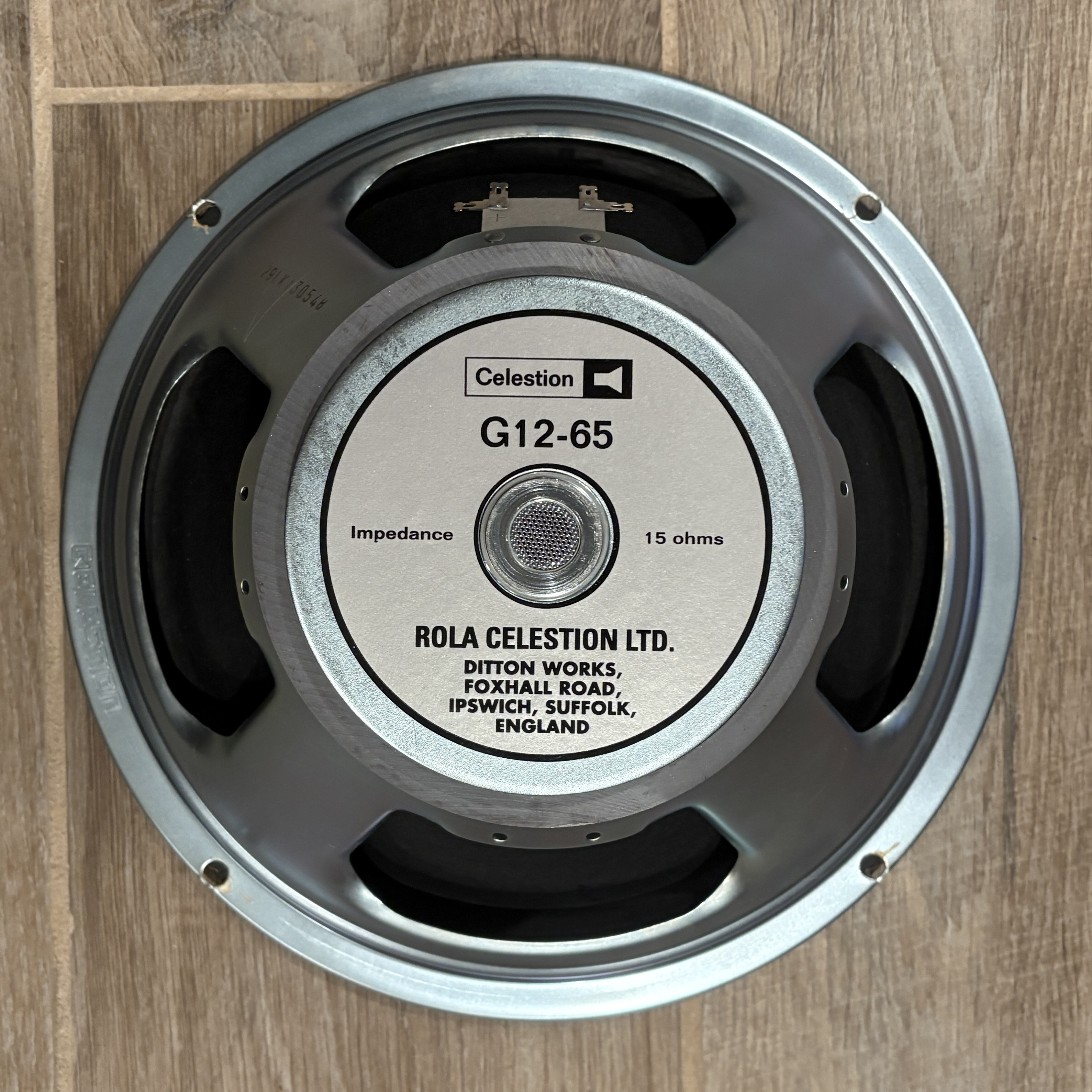
Edit - 2/28/25 - I had a backordered G12-65 Heritage speaker finally arrive. I will be putting the speaker in this cab along with the Classic Lead 80 to experiment for the time being.
G12-65 Heritage
At this time, the musical chairs of Celestion speakers is as follows:
I have started making impulse responses of my Vox Pathfinder 15R 1x8 combo amp.
The signal chain is:
Steinberg UR44 Line Out
Art DTI Isolator
Seymour Duncan Powerstage 170 Power Amp
Vox Bulldog 8" Speaker
Shure SM57 Microphone
Stam SA-73 Preamp
Steinberg UR44 Line In
A 3.0s sine sweep was created in Voxengo Deconvolver. The impulses are 500ms long.
Two 2’ x 4’ x 4” OC703 panels are used to cut down on room ambience, as shown in the photo.
I have started with on-axis captures with an SM57 microphone, and will repeat using varying distances with other microphones.
I started playing around with Voxengo Convolver to make impulse responses of my guitar amp speakers through my home recording setup. 3 sec sine sweeps with 3 sec tails of silence.
I’m starting with the Celestion Greenback and Mojotone BV-30H speakers in my Jet City Vertical 2x12. I’m using a Crate Powerblock as the power amp for now. I’ve recorded sweeps with the Shure SM48 and SM57 into a Stam SA-73, and will go through my mic collection.
Below is a test using Scuffham S-Gear with the IRs used. Tube power amp simulation in S-Gear used.