Featured Post

Click for Links to Cabinet IRs/NAM Captures

Showing posts with label Pedalboard. Show all posts

Tuesday, August 10, 2021

Line 6 HX Stomp Battery Power with Mission 529M

I recently downsized my HX Stomp pedalboard, after establishing my workflow with the unit. I went to a battery powered solution for both portability and convenience. The goal was to be able to quickly set up the Stomp for playing or for mobile recording without having to think about finding an outlet nearby. Another desire was to take advantage of the Stomp's small size to play through it as much as possible.

HX Stomp with battery concealed underneath.

The Fix Pedalboards FP-7X Pedal Riser (6.75" x 5.125" x1.5") is approximately the size of the HX Stomp. I was able to comfortably fit an Anker 10,000 mAH battery, a Mission Engineering 529M power converter, and a USB coupler underneath the Stomp. 

HX Stomp with Pedal Riser.

The 5V 3A current rating of the Anker Powercore 10000 PD Redux is sufficient for the HX Stomp through USB PD, and provides about 3 hours of power. 

The 5VDC out of the PD output of the battery is converted to 9VDC using the Mission Engineering 529M. I went with the Mission 529M due to the Ionic Audio 5V to 9V converter being unavailable for purchase for an extended amount of time.

Battery cabling under Riser.

The 2.1mm center negative output of the 529M needed a combination of Truetone CYR (reverse polarity) and CL6 (2.1mm to 2.5mm, reverse polarity) adapters to interface with the 2.5mm center negative input of the HX Stomp.

A USB coupler is used to reduce wear and tear on the HX Stomp's USB port.


I keep the HX Stomp in an Apache 2800 case from Harbor Freight.

I hear less background noise through my headphones when the Stomp is running on batteries. Whatever noise I was getting previously was likely due to dirty power, desktop fans, sharing a power strip with multiple pieces of equipment, etc. I don’t know if it comes through on recorded DIs, but it is a much more pleasing experience to be monitoring my signal with less noise.

Edit - 11/1/21 - I was successfully able to power my Steinberg UR44 audio interface using the Mission 529M set on 12V. The UR44 requires center positive DC, which was achieved through a polarity inverting cable. The UR44 is not buss powered through USB2, but the 529M along with the Anker battery should provided hours of operation with phantom power engaged.

Going forward, I plan on doing remote acoustic recording with the UR44 and DI recording with the HX Stomp into my iPad Pro. I can do both without the need for an AC outlet nearby.

Friday, October 16, 2020

Line 6 HX Stomp

HX Stomp Pedalboard.

I bought a Line 6 HX Stomp to get myself into the latest generation of hardware amp modelers. I decided to go with the HX Stomp over the Fractal Audio FM3. The smaller size of the HX Stomp is much more favorable at this point, but I do intend to try the Fractal Audio modeling one day.

I was a bit underwhelmed by the modeling in the Line 6 POD HD desktop for years, but started to warm up to its modeling recently. Before getting the HX Stomp, I was playing through the preamp models into a VST plugin chain: Ignite Amps TPA-1 power amp and impulse responses in Redwirez MixIR2. I also started using the POD as a hardware insert for its effect models in Reaper.

My main draw to a new hardware modeler was a standardized input into the digital realm. Gain staging is inconsistent between different brands of VST amp modelers. Furthermore, each interface manufacturer has their own line level input levels. My original reference setup was a Waves/PRS Guitar Interface (gain at minimum) into a Focusrite Saffire Pro 26 Line Input (maximum level +28dBu). I was recording bridge humbucker DIs with peaks at around -10 to -12 dBFS. Kazrog Thermionik amp sims required 6-12dB trims on the inputs, while Scuffham S-Gear required significant boosts (maxing out the input trim at +6dB). I was getting reacquainted with the recording unaffected DIs through the POD HD recently, and it warmed me up to the idea of the Helix family of modelers.

The HX Stomp allows me to record DIs on my desktop or iPad/iPhone at the consistent levels that are appropriate for the Line 6 amp models. Helix input levels were about 3dB lower than my Waves/PRS Guitar Interface - Saffire setup.

Reamp routing with the HX Stomp.

I can record an unaffected direct signal into my DAW while monitoring through the HX Stomp. I can then take the dry unaffected signal and reamp it through my amp using one of the the HX Stomp's loops to fine tune the sound. I like that this sort of reamping can be easily moved from location to location, with my iPhone serving as the DAW. 

USB reamping comparison with real amp and Brit Trem Brt model.

I immediately gravitated towards the Brit Trem Brt model, as this sounded most like my Plexi amp build set to early Lead Spec (split cathode, V1b 0.0022 coupling cap, no V2a bypass cap) with no bright cap. Despite the differences in circuitry, the Treble, Middle, Presence, and Gain knobs were in the same ballpark. The behavior of the Bass knob on the HX Stomp did not scale the same way as the real amp, but I am able to dial in the two sources to be very similar. With the amp's bass on 2, the equivalent Helix setting is about 7. The Brit Trem Brt was modeled after a shared cathode '68-'69 1987 Tremolo with bright cap, which would explain the major difference. The noise floor is much better with the Helix model when compared to the real amp, which is a major plus.


A comparison between the HX Stomp Brit Trem Brt and Brit Trem Nrm models against my Plexi buildwith the bass set on 0.

I have a Dunlop DVP4 mini expression pedal and Mosky single footswitch assigned to EXP1 and FS5 inputs respectively. To get the DVP4 working, I had to flip the internal dip switch to Expression, and set the HX Stomp's expression polarity to Inverted.

Wednesday, June 3, 2020

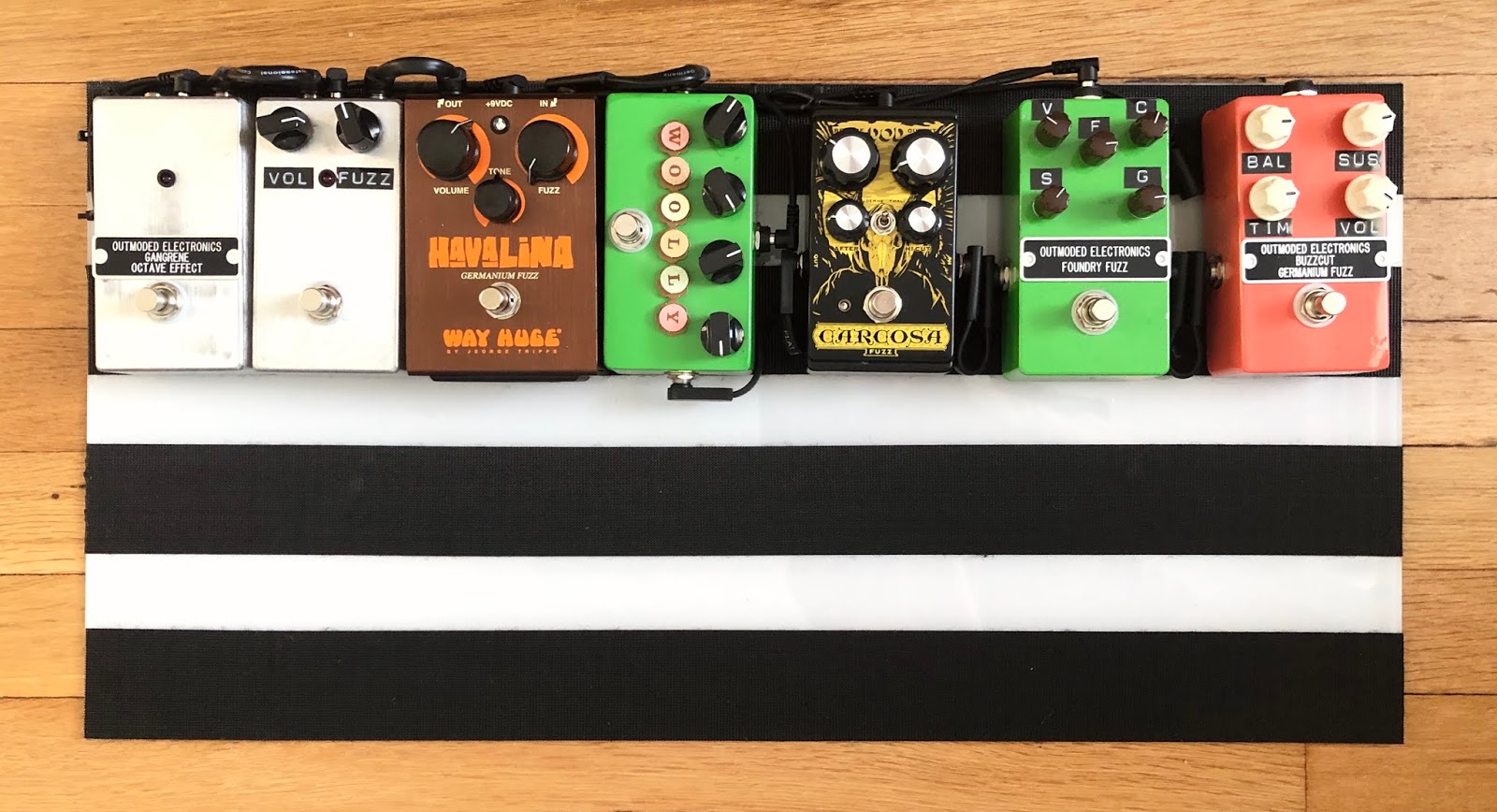
Fuzz Pedalboard Build


I decided to put my fuzzes all on one board to have as many fuzz textures available at once when recording.

I have so far populated the top row, which will be the A path.
Buzzaround Clone —> Fuzz Factory Clone —>DOD Carcosa —> Woolly Mammoth Clone —> Way Huge Havalina —> Fuzzrite Clone — Green Ringer Clone

Fuzz demo of A path on YouTube


An A/B switch box will have a B path connected to it as well.
The plan for the B path is: Fuzz Face Clone —> Harmonic Percolator Clone —> Companion Fuzz Clone —> Meathead Clone —> Behringer SF300 —> Boss HM-2

The pedals secured using Velcro to a 12”x24” acrylic sheet. An Electro Harmonix pedal bag will house the board.

The Buzzaround is the lone positive ground effect. Two Snark power supplies will be used for the board when needed.

I moved the Havalina and Carcosa off of another pedalboard.

8-12-20 - I finally got an Electro Harmonix pedal bag. The bag holds my pedals and the acrylic sheet fairly snuggly.

I will be housing the PedalPCB Fuzz Face, Companion Fuzz, and Harmonic Percolator clones in a single 1590DD enclosure from Love My Switches. The A/B switch will be built in a 1590BB enclosure with a switchable pickup simulator circuit. 

Almost completed with 2 more pedals to go.

PCBs for Fuzz Face, Harmonic Percolator, Companion Fuzz.

9/8/20 - Drilled pickup simulator enclosure.

11/12/20 - A/B Switch and Pickup Simulator wiring planning.

11/12/20 - An unused twin-blade pickup from EY Guitar Parts will be used to for the pickup simulation box. I will wire the pickup onto an On-On DPDT switch for series-parallel wiring of the pickup. The pickup will be wired to a 500K volume/500K tone control circuit.

I have decided to build a straight PNP Fuzz Face in the 1590DD enclosure, and will save the PedalPCB PCB for a standalone build. I don’t want to take a chance with mixing a charge pump with 12 other fuzzes.

11/20/20 - The A/B switch and in-line pickup simulator was completed today. 

Completed build of in-line pickup simulator and A/B selector.

12/13/20 - The prepping of the Fuzz Face/Companion Fuzz/Harmonic Percolator enclosure has begun. I am hoping that this will be the catalyst for the build to actually get done. The Companion Fuzz and Harmonic Percolator circuits will be powered off the pedalboard daisy chain. I will add a second DC jack to provide an external 9V battery connection via a Voodoo Lab Battery Snap to 2.1mm connector to the Fuzz Face circuit. 

Drill template for the 1590DD enclosure.

.

Thursday, June 13, 2019

Budget Dirt Pedalboard


Signal Flow
DOD Carcosa
Way Huge Havalina
Way Huge Saucy Box
BBE Green Screamer
DOD 250
DIY SHO Clone
DIY Fetto Clone
DIY Red Llama Clone
DOD Boneshaker
DIY Distortron Clone

The pedals were mounted with Velcro on a piece of 22”x12” lexan. A Roadrunner All-In-One Pedalboard Gig Bag houses the pedals. A 10-pedal daisy chain is used for power connections. EBS flat patch cables and pancake patch cables were used to interconnect pedals.

All pedals are either DIY or impulse sale/clearance buys.

Video of Green Screamer, Saucy Box, 250, SHO Clone, SD-1 (not on board) boosting a Fender Pro Junior


Video of Jet City JCA22H boosted by the same pedals plus a DOD Boneshaker

Wednesday, April 24, 2019

New Pedalboard


Signal Flow
Loop A
-Monoprice Compressor
-Digitech EX-7
-DOD 440
-DOD Gonkulator
Loop B - External Pedals
Behringer UV300
EHX Small Clone
EHX Small Stone
Ibanez PM7
Mosky Spring Reverb
Ibanez DE7

Pedals were installed on a Donner DB-3. Two Snark 9VDC power supplies power 5 pedals each. The Digitech EX-7 is powered off the factory 9VAC power supply.

Loop B is used to patch in different drive pedals.