Featured Post

Click for Links to Cabinet IRs/NAM Captures

Showing posts with label Guitar Amp. Show all posts

Sunday, November 2, 2025

Mesa Boogie Rectifier Traditional 4x12

Mesa Traditional 4x12.

I grabbed a reference-quality 4x12 cabinet for $600 from Main Drag Music. The cabinet is a Mesa Boogie Straight Traditional 4x12. While the cab is not the mythical Standard Oversized cab, the Traditional size does have its fans. The Traditional 4x12 apparently is more mid-focused and not as scooped sounding as the Oversized 4x12.

Mesa 4x12 opened up.

The cabinet is loaded with four 8 ohm 70W Mesa OEM Vintage 30s produced in May 2001. The early 2000s are considered to be a desirable period for the V30 as a result of the ubiquitous use on rock and metal albums. Mesa Boogie let me know that the cabinet was shipped in April 2002.

T4335 Vintage 30 with 18EL date code.

These Mesa Vintage 30s do indeed sound less harsh than my other Vintage 30s. For the past few years, I’ve moved around my 2011 MIC Vintage 30 from cabinet to cabinet to get it to sound like every other clip online. I can stop trying to approximate that sound with this Mesa cabinet now. Whatever the recipe may be (UK manufacturing differences, 8 ohm impedance, cabinet construction), it sounds good. I also have four speakers to choose from for variety in a recording context.

Impedance Measurements
Blue: Mesa Traditional 4x12 - V30
Teal: Suhr Reactive Load

The cabinet sounds great with all of my high gain amps. The cabinet sounds balanced to me in the room. Listening to the speakers under a microphone confirms for me that there isn't a single sweet spot to a Vintage 30. Like with my other V30s, there are different zones to the speaker that sound best to my ears depending on the amp:

  • Cap Center to Cap Edge: Mesa Rectifier Multi-Watt Vintage Mode, Crab Benzin VH3 Mode (Diezel VH4 sound), Mesa Badlander Crush Channel
  • Cap Edge: Mesa Rectifier Multi-Watt Modern Mode, Mesa Badlander Crunch Channel
  • Slightly Outside Cap Edge: Peavey 6505, Jet City JCA22H, Crab Marcus (Mesa Mark III sound)

Each V30 in this cabinet is slightly different in terms of frequency response. The most obvious difference seems to be in the 2-3k region, in which the two right speakers have more of. The lower left speaker seems to sound the most balanced for my tastes. I will share IRs of this cab to demonstrate the differences at some point.

I have recently gained a greater appreciation of the nuances between individual speakers within a cabinet. I have learned that there isn’t a monolithic sound for each speaker, rather subtle differences within a single model.

More to come.

Tuesday, October 28, 2025

Marshall 1960TV 4x12 Cabinet

Marshall 1960TV 4x12.

I recently found a used Marshall 1960TV 4x12 cabinet available online at a price that I had to jump on. I noticed that it had a December 2020 production date, which meant that it likely had UK Greenbacks. I watched the cab get marked down 3 times and had to go for it. I thought I was done buying gear for the year, but some good deals for cabs have come up recently.


1960TV rear panel off.

I was a bit surprised by some of the construction choices of the 1060TV. I was not expecting handles or the jack cup to be plastic. I’ve read mixed feedback concerning the long-term reliability of the handles. The long flathead screws used all over the cabinets were interesting. I understand the use of the partial thread screws for the back panel, but not for the attachment of the baffle to the front of the cabinet.

Impedance Measurments
Green: Marshall 1960TV - G12M25
Orange: EVH 5150III 4x12 - G12-EVH
Blue: Suhr Reactive Load

The voicing of the speakers is reminiscent of other reissue MIC 25W Greenbacks, with a roll off of high end. Pointing a Shure SM57 at the center of the cap is usable compared to the MIC reissue. This cab/speaker combination does not have the big lower mids of my 5150III 4x12 with 20W G12-EVH speakers. I treat the G12M25 and the G12-EVH speakers as distinct families of speakers. I think Plexi-level gain can sound a lot heavier with G12-EVH speakers, whereas the G12M25 maintains its classic rock voicing.

Celestion Greenback.

I took off the back panel to take a look at the speakers. I confirmed that the Greenbacks were indeed made in the UK with a production date of October 28, 2020.

More to come.

Monday, September 22, 2025

EVH 5150III 4x12 Cabinet

I’ve been on the hunt for a quality 4x12 cabinet to pair with my tube heads. I considered a Mesa Standard 4x12, but couldn’t get past spending $1500+ on a new cabinet. I also wanted to use a 4x12 with my lower gain amps. I liked how the EVH 5150III 4x12 Dynacab pack from Fractal Audio sounded for both crunch and high gain, so I was open to the idea of acquiring the cabinet. The cabinet is supposed to be based on the construction of the classic Marshall 1960B 4x12 and is loaded with EVH-labeled Heritage Greenbacks.

5150III Cabinet Front View

A blem EVH 5150III 4x12 from Musician’s Friend appeared in my Google searches for 4x12 cabinets. The cabinet appeared new in the images with the exception of some scuffing on the metal corner protectors. At $500 off the new prices, I didn’t think I would see this price again.

Celestion G12-EVH speakers.

The cabinet came single boxed with no padding other than a few pieces of cardboard at the base. The cab itself was in great condition, with the original tag and plastic over the logos still intact. Some minor bumps to the edges on the rear, but nothing that would lead me to return the cabinet. I opened up the cabinet to verify that the G12-EVH speakers were all accounted for. An inspection sticker was dated 09/05/2025, so still within a month of purchase. This cabinet most likely had a rough time during shipping and the original box was worn enough that it couldn’t be sold as new. The speaker connections are soldered, so I don’t think that I will be doing any speaker rolling in this cabinet.

Celestion G12-EVH T5600B code.

My first impressions of the cab mirror the experiences of others. The cabinet is darker sounding and the big low end of the G12-EVH is somewhat loose. The darker Greenback flavor conplements bright Plexi and JCM800 sounds, both in the room and under a microphone. The cab sounds good with high gain as well. I really liked how the voicing worked with my Peavey 6505, Mesa Dual Rectifier Multi-Watt, and Crab Marcus. The G12-EVH works better with the 6505’s Crunch Channel than any of my other speakers. I thought the low end was a bit much with my Crab Benzin’s VH3 channel.

I wonder what about the combination of construction and speakers gives the cabinet such a big sound. All of the G12-EVH speakers consistently sound thicker than my G12M25 (Jet City 2x12) and G12M65 (Line 6 4x12). 

Edit - 10-23-35 - I made some NAM Full Rig captures with my Plexi amp and the cabinet. The amp-cab combination has been great. The darker voicing of the cab smooths out the amp quite a bit. It sounds great at all gain ranges of a Plexi circuit. I thought the low end would be too much for Bass Spec sounds, but I was wrong.

https://www.tone3000.com/tones/full-rig-amp-head-50w-plexi-circuit-evh-5150iii-4x12-115dbu-ttsv10-40733 

More to come.

Saturday, September 20, 2025

Speaker Impedance Curves

I've been wondering about how the Suhr Reactive Load compares to my speaker cabs as an output presented to my tube amps.

Suhr Reactive Load (Green) vs V30/H75 in my Jet City 2x12 (Blue)

I used a Dayton Audio DATS V3 to take some measurements to compare the impedance curves of various speaker configurations vs the Suhr Reactive Load. The Suhr Reactive Load is meant to mimic a Marshall 4x12 with Greenbacks as a reference. I was surprised how close its impedance curve compared to my Vintage 30/Creamback H75 combination (illustrated above).

I am looking into recording my tube amps with speaker loads when my playing environment is favorable to loud noise. The Suhr Reactive Load + IRs will continue to be tools that I utilize, but there is excitement in pushing air and moving microphones. 

The accuracy of my lower gain amp DI captures should benefit from using complementary speaker loads. The Suhr’s 4x12 response adds some beef for rock tones, but it can be a bit much for some edge of breakup tones.

For those times that I cannot turn my amps up, my plan is to capture my amps in NAM with a speaker load. 

NAM Speaker Load Captures vs Suhr Reactive Load Captures

https://www.tone3000.com/tones/vox-ac15c1-normal-channel-115dbu-ttsv10-input-31553

https://www.tone3000.com/tones/vox-ac15c1-top-boost-channel-115dbu-ttsv10-input-37813

NAM Full Rigs

https://www.tone3000.com/tones/full-rig-peavey-6505-1992-original-115dbu-ttsv10-36456

https://www.tone3000.com/tones/full-rig-mesa-boogie-dual-rectifier-multi-watt-red-modern-115dbu-ttsv10-39074

https://www.tone3000.com/tones/full-rig-amp-head-peavey-6505-1992-original-lead-evh-5150iii-4x12-115dbu-ttsv10-40737

https://www.tone3000.com/tones/full-rig-amp-head-mesa-boogie-dual-rectifier-multi-watt-red-modern-evh-5150iii-4x12-115dbu-ttsv10-40735

https://www.tone3000.com/tones/full-rig-amp-head-50w-plexi-circuit-evh-5150iii-4x12-115dbu-ttsv10-40733

Varying speaker impedance curves is something I already explore in my Fractal FM3. Adding the contribution of my speakers to my digital tones via NAM is the next logical step.

Tuesday, August 5, 2025

Crab Guitar Effects Marcus

I decided to buy a Marcus 50W amp head from Crab Guitar Effects. It is inspired by the Mesa Boogie Mark IIC++/III series amps and is likely the most popular Crab model. The amp took about 11 weeks to build from my order in May 2025. The lead time increased by approximately 1 month since I last ordered a Benzin head. Shipping from Ukraine to the NE USA then took 9 days.


I am not particularly educated about Mark-series amps, but am excited to explore the tones in the amp. The cleaner mode is selected with the Drive push-button off, while the most common distorted lead and rhythm tones are achieved with the Drive engaged. I had to read the Mesa Mark IIC+ reissue manual several times to understand the functions of the switches.

I started off with the more distorted channel/mode. I turned the bass/middle off, treble/presence high, and adjusted the 5-band EQ. The graphic EQ affected the sound in a drastic way. I turned each band up/down for the most pleasing sound until I arrived at the setting shown in the photo. I arrived at the general V shape, except I preferred the 6500Hz slider around the middle. 

There are many push-button switches in place of the push-pull pots of the Mesa amps. My initial preference for lead tones is Deep-On, Bright-Off, Boost-Off, Bass Shift-Off, and Treble Shift-On or Off depending on mood. 

With the Drive off, I was able to dial in some nice clean tones.

I quickly put together a short mix using my Ibanez SZ520 into the Marcus. The speaker out was connected to my Suhr Reactive Load to get into my DAW. I used my 4x12 Vintage 30 IRs for the cab simulation.

Rear of the Marcus.

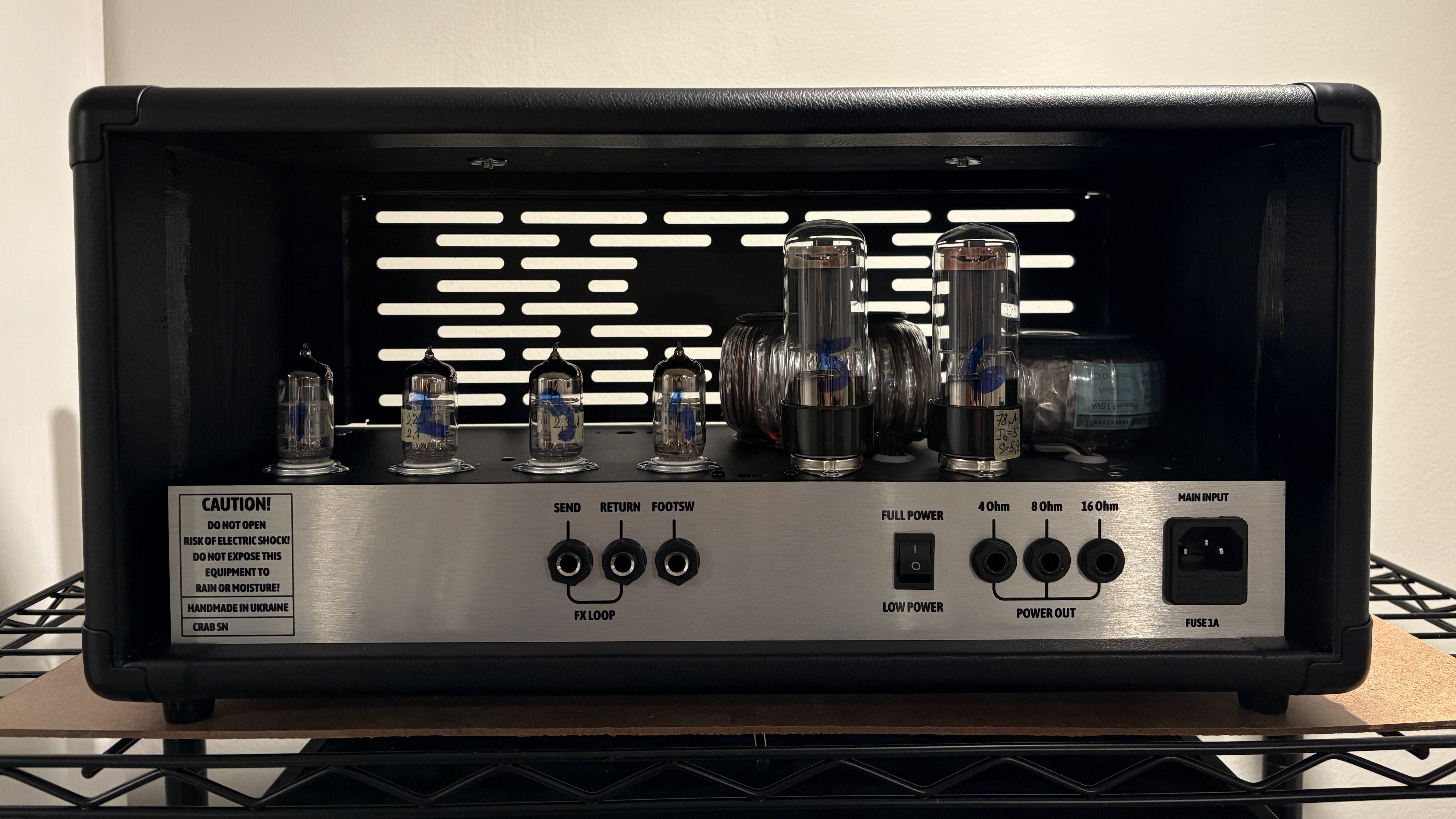
The rear panel has a C++/III switch, which I can only guess is similar to the Crunchberries amp. Otherwise, the rear panel features are the same as the other Crab amps (series effects loop, pentode/triode switch, foot switch input, 4/8/16 ohm jacks).

It is clearer on this Marcus what Crab Amps is providing on these amps for tubes. The preamp tubes are likely 6N2P, as the back panel is labeled ECC83/6N2P. The power tubes have visible 6N3C labels on them. These are apparently the Soviet-era equivalent of the 6L6GC power tube. My Crab Benzin did not have any markings to identify the tubes.

Old Crab Footswitch on the Left, New on the Right.

A 2 button foot switch is provided to access the Drive and Boost front panel functions. The new footswitch has labels to better identify the functions.


Thursday, April 3, 2025

Mesa Boogie Rectifier Badlander 50 Combo

The Mesa Boogie Rectifier Badlander 50 Combo was featured as Musician’s Friend Stupid Deal of the Day at $1299. This price was better than used prices by several hundred dollars, so i had to jump on the deal. A total impulse buy, but perhaps one that is actually worth it.


The amp is said to be more on the Marshall-side of the tonal spectrum, like a Stiletto or Triple Crown rather than a Rectifier. When the Badlander was introduced in 2020, it was assumed that the amp would be voiced like the Vintage/Modern channels of the typical Rectifier series. The Creamback M65 that comes in the amp does give it a more British voice. The speaker is 8 ohms and sounds much smoother than my 16 ohm Creamback M65 that I’ve loaded in various cabs.

With some tweaking, I was able to dial in the Crunch mode to sound similar to Vintage mode on my Dual Rectifier Multi-Watt by dialing back the treble and presence. Cranking the gain on the Clean mode gets some dirt, like a different flavor of the Pushed mode of the Recto Multi-Watt’s Green Channel. It doesn’t quite get the same level of gain as my Plexi cranked, but I thought I was able to dial in a few similar tones.

For rock tones, I am generally happy with the Crunch channel’s gain around 2/3 of the way up. The Crunch channel can be boosted with the gain cranked for heavier tone. The Crush channel is a little more loose in the low end. The gain of the Crush channel can easily be cranked, but I prefer to back the gain off a bit if I am boosting the input.

The combo itself is compact. My Vox AC15 combo and Eminence 1x12 Extension Cab are wider than the Badlander 50. The omission of diamond plate makes this Badlander look more like a low gain boutique combo.


I posted some captures on TONE3000 of the amp. I used some synced DI and video clips to make a short video demonstrating some of the tones of the amp.


To be continued.

Monday, March 24, 2025

Crab Guitar Effects Benzin Head (Inspired by Diezel VH4)


My order of the Benzin 50W head, inspired by the Diezel VH4, is making its way from Ukraine to the US. I contacted Crab Guitar Effects through FB Messenger to put the order in. My amp was shipped a little over a month after I put my order in.

Edit - 4/8/25 - The Benzin has arrived. The amp was well packed, with styrofoam on all 6 sides and several layers of bubble wrap. The box got to me with minimal damage as it passed through multiple countries.

Here are some the features:

  • 4 preamp tubes instead/ 2 power tubes
  • Toroidal power and output transformers
  • 50W output
  • 2 sets of EQ: VH1/VH2 and VH3/VH4
  • Footswitchable between VH1/VH2 and VH3/VH4
  • Tone Shift to take out lower mid frequencies
  • 1 serial effects loop

I wanted to get use out of all four channels of this amp.

  • VH1 - I like this channel the least. I’ve been spoiled by the cleans on the Dual Rectifier Multi-Watt and Rectifier Badlander. Whereas the Recto Multi-Watt’s clean seems to be perfectly matched with V30s, the Benzin’s clean sounds a bit honky through the same speaker.
  • VH2 - I was hoping to get JCM800-type tones out of this channel, and it does a great impersonation. Setting all of the tone knobs around 12:00 with the gain past 1:00 sounds very Marshall-like, especially through Greenbacks.
  • VH3 - This is the sound that everyone associates with the Diezel VH4. This channel sounds like all of the clips that I’ve been hearing online. The low end is big sounding. The hope for a thick high gain voicing was main reason why I went with the Benzin over the Mesa Mark-inspired Marcus model. I came across some marked settings from Adam Jones. He apparently turns the Treble (4:00) and Mids (Maxed) up very high.
  • VH4 - This is a gainer and more compressed version of VH3. The level of gain seems on pair with the 5150/6505 Lead Channel. I don’t think I would deviate from setting the gain between 9:00 and 11:00.

Crab Benzin front.

Crab Benzin rear.


The Benzin is compact in relation to a typical head.

I took a look inside the chassis. The amp looks nice all around. The earlier examples of amps by Crab Guitar Effects appeared to have etched boards, but recent amps look like they are all populated with PCBs.

Benzin Guts.

Benzin preamp tube wiring.

Benzin on.

The video below is a demo of the amp that I posted on Youtube.

To be continued.


Wednesday, January 22, 2025

Mesa Boogie Dual Rectifier Multi-Watt

My interest in acquiring a Mesa Boogie Dual Rectifier grew as I revisited the popular rock music of the 1990s and 2000s. It was a staple in all of the rock concerts that I went to as a kid in the early 2000s: in arenas, in tiny clubs, and on the Warped Tour. After going through all of the punk, emo, nu-metal, and metal albums that were recorded with Rectifiers, I knew that I wanted to have the amp.

With the new 90s Dual Rectifier being released, there were rumblings that the Multi-Watt version would be discontinued. I had been reading up on the Multi-Watt version for some time, but wasn’t enamored with its $2700 new price. I heard about its Lonestar-inspired clean channel, and it’s improved dirty voicings through many different discussion boards and demo videos.

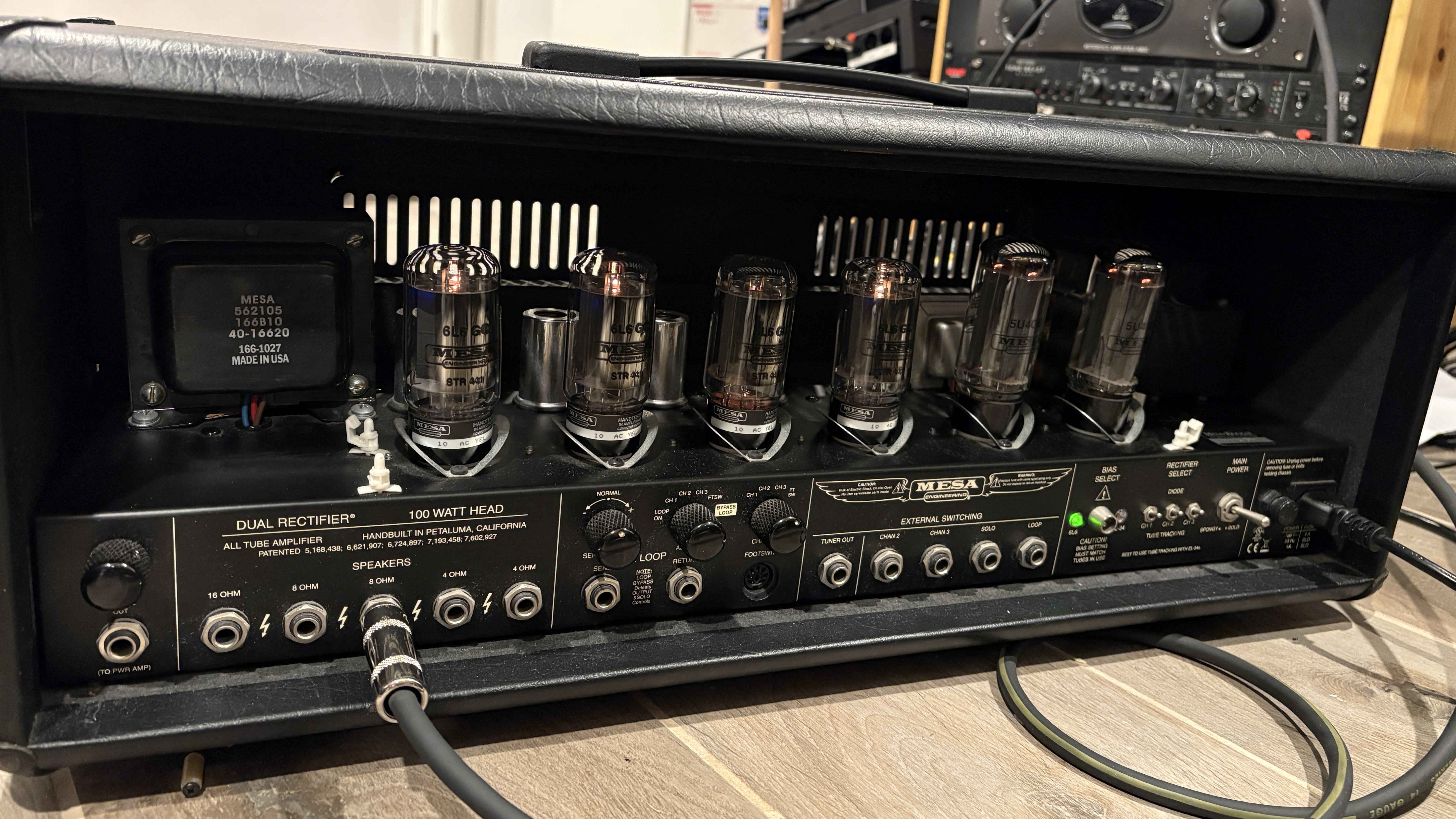
A used Multi-Watt came up on the Guitar Center site at a good price via a tip on a forum and I jumped on it. The amp was just labeled as a regular Dual Rectifier. The tiny details such as the “100W Head” vs the “Solo Head” logo and the wattage switches on front panel required some zooming to discern. Once I received, I saw that the chassis was dated December 2010, so it is an early example of the amp’s run. The previous user had installed STR447 EL34 tubes in the amp.

Mesa Boogie Dual Rectifier Multi-Watt

Disappointingly the amp did not power on when I received it. I replaced the bad 4A fuse, but the new fuse still blew with the with a subsequent power on/standby off. This behavior hinted that the rectifier tubes were a problem. I wanted to see if I could get it working again before resorting to returning the amp. I inspected the rectifier tubes and noticed that one had a part that was rattling around. Indeed, one of the 5U4 tubes was bad and was likely causing the amp to shut down. I didn’t want to take any more chances on the tubes.

I looked at a typical 3-Channel Rectifier schematic and noticed that the rectifier tubes were still in the circuit in diode mode. The screen grid resistors were all measuring 1kohm while the amp was off. The resistors looked like they were in good shape, along with the rest of the PCB. I decided to change out all the tubes in the power section, not knowing how old the tubes were. 

Dual Rectifier with all tubes functioning.

I put in new STR441 6L6 power tubes and 5U4GB rectifier tubes along with a new fuse. The amp powered up successfully in Bold Mode with the Diode Rectifier selected for all 3 channels.

I am still learning the nuances of the tone controls of the amp. I have mainly stayed in Channel 3 Red, switching between Vintage and Modern modes. Turning on Vintage mode and palm muting a Les Paul immediately reminded me of the sound on Ocean Avenue by Yellowcard. It was fairly effortless to find a sound reminiscent of the intro of The Hell Song by Sum 41. 

Modern mode adds a large volume boost and the ubiquitous scooped nu-metal voicing of the late 90s. I needed to dial the Bass control back considerably below 11:00 to control the amp in Modern Mode. My Treble, Middle, and Presence settings have hovered around 12:00 in most cases. The EQ seems very touchy, as turns of 0:30 in o’clock settings seem to have big changes. On both channels, I prefer the amp’s Gain control to be in the 12:30 to 2:00 range on the Vintage and Modern modes.


I’ve spent some time with the Clean Mode of the Green Channel. Its relation with the Lonestar circuit is a major reason why I wanted to go with a Multi-Watt Dual Recto over a Solo Head. The Clean Mode stays clean for most of the gain range with my lower output pickups, so I tend to keep the gain control around 12:00. I like chow cleans come through my V30 speaker best. I’ve got no real amp counterpart for a Blackface clean sound, but the cleans on this Rectifier are good enough for me at this time. 

I was surprised how much I liked the Pushed mode of the Green Channel with single coils. The Pushed mode can get a crunch sound that sounds like an entirely different amp. The sounds are slightly broken up at low gain settings (<11:00) and work well with neckups. Medium settings are crunchy, and outright distorted at the top of the dial. I prefer the bridge pickup at these higher gain levels.

I made a short clip of the Red-Modern and Orange-Modes at low volumes, linked below:


More to come.


Friday, July 26, 2024

Vox AC15C1 Combo

Vox AC15C1.

I’ve been looking for a Vox sound to incorporate into my setup and the digital models  have left me wanting more. The Winfield Typhoon that I already had worked best with single coils, sounded best clean, and its EF86 preamp was a different vibe than a top boost or normal channel.

My first inclination was to fire the AC15 up with a Tele. I was immediately hearing the “chime” that is present so many famous songs. The amp seems like it will be a great fit for all my oddball single coil guitars. I am already enjoying being able to dial the Top Boost channel with my darker sounding Gretsch G5420T. The amp of course pairs well with my Strat and Tele guitars. The AC15 sounds great at the top range of its gain as well. It took me a while to get used to the voicing, but I've come to like the Top Boost channel cranked with humbucker guitars.

I am a fan of its clean, breakup, and cranked sounds. When recorded, it doesn't have that crackly sound that can appear with sustained notes. There are usable sounds at every gain level. 

The master volume is a very useful feature and allows for saturation at sane levels when I am sitting near the amp. It works well to balance levels when recording.

Edit - 9/12/24 - I spent about a month making captures of the amp in NAM and got a good feel for the amp along the way.


I've been able to approximate several tones from albums that featured the AC30. I was able to do this by combining the AC15 with updated impulse responses of my Weber Ceramic Blue Dog speaker.


More to come.

Tuesday, May 7, 2024

Peavey 6505 Original 1992 Amp


I’ve been wanting a Peavey 5150 on and off for years, and finally jumped at the new Peavey 6505 Original 1992 model. The 5150 is a classic amp in hard rock and metal, and I wanted to experience the real thing after playing through the various digital models of it over the years.

A quick clip of my Epiphone Les Paul through the Lead Channel, first through a V30, then a CL80:

I’ve been focusing my time on the Rhythm Channel, with Crunch and Bright settings engaged, to dial in rock rhythm sounds. The most useful sounds to me  on this channel are with the Pre-Gain at 6-7, EQ at moderate settings, Resonance 5-8, and Presence around 8. From reading various forums, a popular way of running the amp is boosting the Rhythm channel with the Pre-Gain around 6.

The Lead Channel is much higher gain. Setting the Pre-Gain at 3-4 is where I top out at. It is a tighter and thinner sound compared to the Rhythm channel. 

As I dug deeper into the 6505, I wanted to try the ubiquitous Fredman mic technique. I initially thought I would just set up 2 mic stands, but I was too lazy. I ended up buying a mic clip from Fredman Digital to do it the right way. The intended angle of the off-axis mic is apparently 55 degrees. I didn’t have a second SM57, so I used a Shure 545SD instead. I can see why it was such a popular way to record the Peavey 5150.

Fredman mic clip.
I ended up capturing the amp for NAM with settings I would typically use. I set the amp up at 4 gain levels on each of the channels, boosted and straight in. A few sound samples are below.


Although the 5150 is typically paired with Vintage 30s, I am enjoying the recorded tone more with my CL80 and V-Type speakers.