I finished vero board builds of a Buzzaround and a Naga Viper based on the layouts from the Tagboard Effects blog (Buzzaround Link and Naga Viper Link). Passive components are mostly sourced from Tayda Electronics. Enclosures are from Mammoth Electronics.
Buzzaround Clone Guts.
The Buzzaround is wired as a -9V effect. I added a 100KA pot for a volume control.
Smallbear PNP Transistors.
I bought a PNP transistor set from Smallbear Electronics. Q1 and Q2 are Motorola-branded transistors of an unknown make, with markings of “9270 336” on the transistors. Q3 is a Texas Instruments 2N404A with a HFE of 140, mislabeled on the bag, but consistent with typical Buzzaround values. I also ordered the 1N270 germanium diode from Smallbear.
Video of Buzzaround Build
Naga Viper clone guts.
I had trouble fitting the vero board into the enclosure due to the height of the electrolytic capacitors I used, so I installed the board at the bottom of the enclosure. Despite the long connections to the pots, the pedal is fairly quiet for much of its gain range. A 2N2222A transistor was used.
Video of Naga Viper Clone through Fender Pro Junior and 5F1 Clone
My next pedal projects are Son of Screamer and Honey Bee pedals using the respective Tagboard Effects vero layouts.
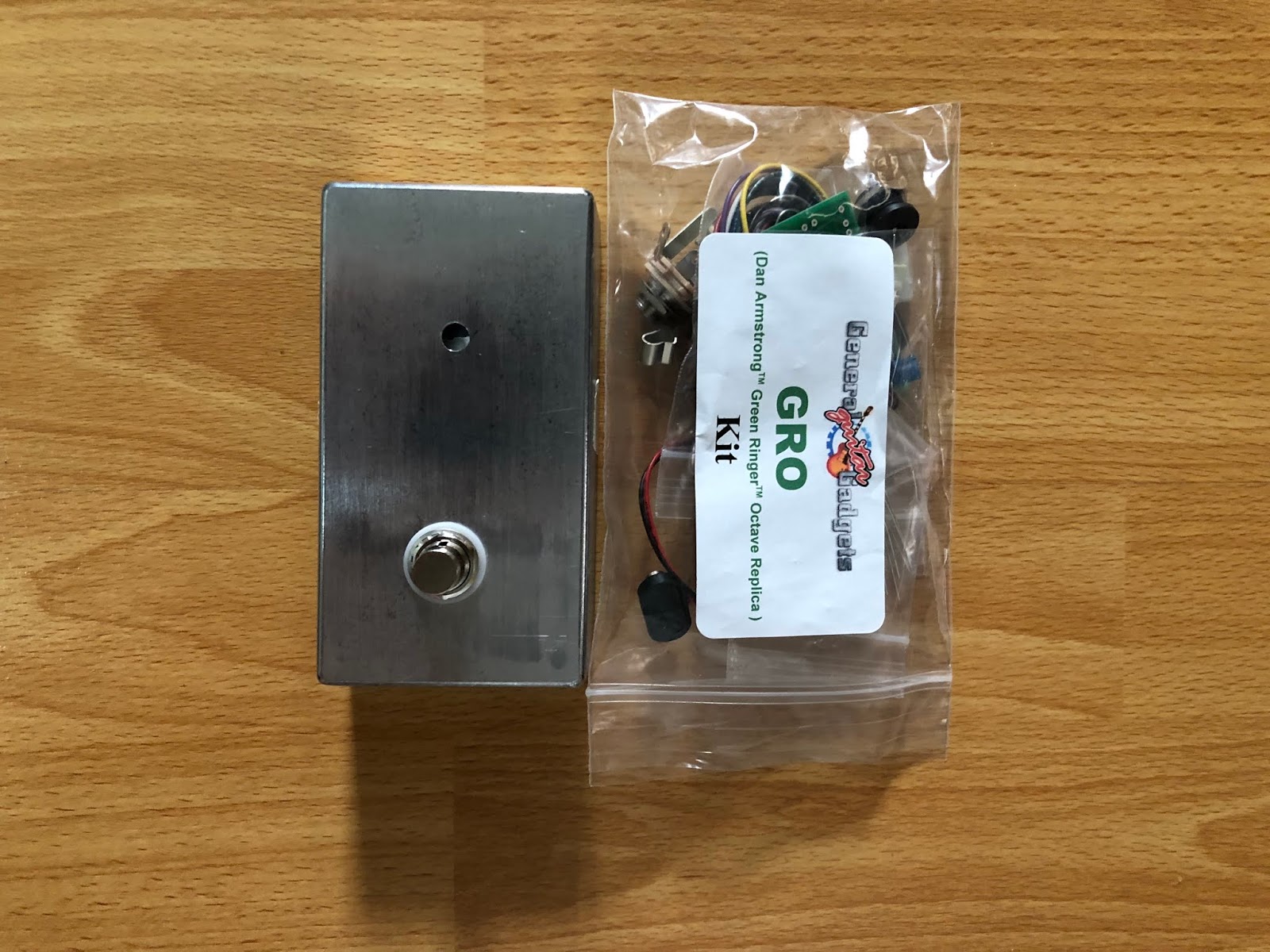
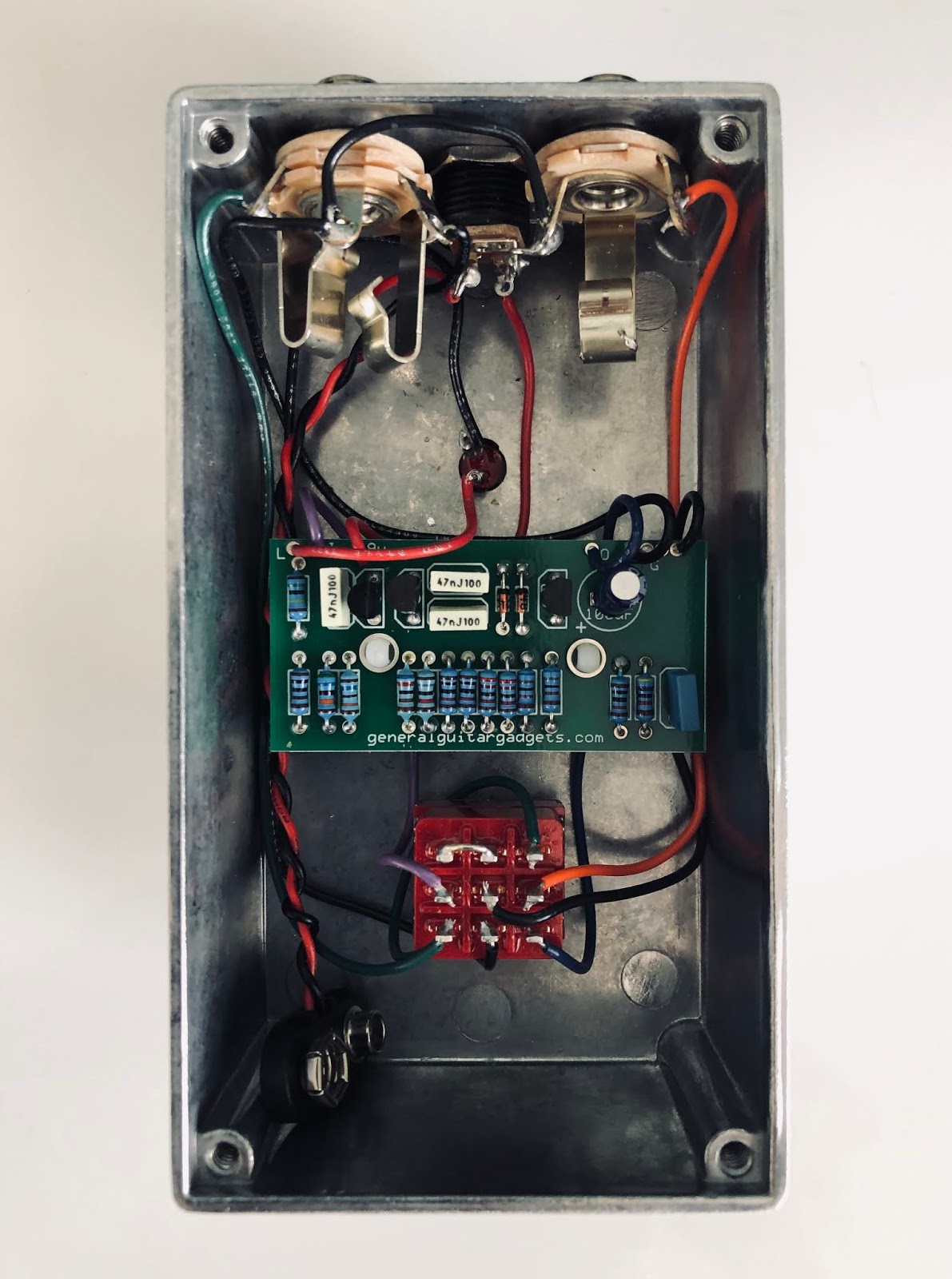
I bought a Green Ringer pedal kit during the General Guitar Gadgets recent sale. I had attempted 2 unsuccessful builds of a Green Ringer on vero board in the past.
The kit came with 2 2N5089 transistors (Q1, Q3) and a MPSA92 PNP transistor (Q2), with 1N4148 diodes.
I had originally tested the pedal by reamping a recorded guitar signal, and came across a persistent hum. I rechecked continuity through all of the solder joints.
However, the effect worked properly when interfaced with an electric guitar’s pickup. The effect seems sensitive to impedance. With a pickup simulator in front of the pedal, the hum was not present.
The pickup simulator is an older build, based on the project on the AMZ website (Link). I used the same 42TL019 10KCT:600CT transformer, with switchable capacitor values based on the AMZ (330pF) and DIYRe (820pF) versions. The transformer secondary is switchable between using the full windings and the center tap to simulate Humbucker and Single Coil pickups respectively.
As I upgraded some of the 2W metal film resistors to 3W on the 1987 turret board, I started populating a board for a future 5E3 head build that I have been putting off.
All passive components are now ordered except for the filter capacitors and a diode for the 1987 board. I am now considering installing a hi/low B+ voltage switch on the Plexi. I plan on using the 625V tap on the ClassicTone 40-18095 power transformer, but am thinking about utilizing the 690V or 560V taps.
The 5E3 will likely be a straightforward build, with little or no modifications. Parts will be Vishay metal film resistors, Vishay MKT1813 and Cornell Dubilier 150 film capacitors, F&T filter caps, Cornell Dubilier silver Mica capacitors, and ClassicTone transformers.
Signal Flow
DOD Carcosa
Way Huge Havalina
Way Huge Saucy Box
BBE Green Screamer
DOD 250
DIY SHO Clone
DIY Fetto Clone
DIY Red Llama Clone
DOD Boneshaker
DIY Distortron Clone
The pedals were mounted with Velcro on a piece of 22”x12” lexan. A Roadrunner All-In-One Pedalboard Gig Bag houses the pedals. A 10-pedal daisy chain is used for power connections. EBS flat patch cables and pancake patch cables were used to interconnect pedals.
All pedals are either DIY or impulse sale/clearance buys.
Video of Green Screamer, Saucy Box, 250, SHO Clone, SD-1 (not on board) boosting a Fender Pro Junior
Video of Jet City JCA22H boosted by the same pedals plus a DOD Boneshaker
The rear of the chassis was drilled out for the power (Neutrik Powercon) main and HT fuses, bias test points, and various tone mods.
The main perfed turret board is from ValveStorm. Black turret strips are from Antique Electronics Supply (Tubes and More).
I am drafting the layout in AutoCAD to tentatively coordinate the various theoretical locations of drilling points. All holes smaller than 3/4” will be hand drilled. Holes for tube sockets and capacitor cans will be made with the corresponding Greenlee hole punches.
Finalized wiring layout to come prior to further drilling of the chassis. I am trying to find time to coordinate turret board mounting with the mods (black turret strips), Larry grounding, and transformer wiring based on the specific Classictone transformers I plan on purchasing.
I have started making impulse responses of my Vox Pathfinder 15R 1x8 combo amp.
The signal chain is:
Steinberg UR44 Line Out
Art DTI Isolator
Seymour Duncan Powerstage 170 Power Amp
Vox Bulldog 8" Speaker
Shure SM57 Microphone
Stam SA-73 Preamp
Steinberg UR44 Line In
A 3.0s sine sweep was created in Voxengo Deconvolver. The impulses are 500ms long.
Two 2’ x 4’ x 4” OC703 panels are used to cut down on room ambience, as shown in the photo.
I have started with on-axis captures with an SM57 microphone, and will repeat using varying distances with other microphones.
Pedals were installed on a Donner DB-3. Two Snark 9VDC power supplies power 5 pedals each. The Digitech EX-7 is powered off the factory 9VAC power supply.
Loop B is used to patch in different drive pedals.
I have started to build a 50W guitar amp, based on typical 1968 Marshall 1987 Lead Spec documentation found on the Internet.
The amp will have front and back panel toggle switches, to have options from the shared cathode Plexis and later Lead Spec Marshall circuits.
I will be using a Hammond 1444-32 chassis and 1451-22BK3 cage. By skipping the traditional Plexi cosmetics (headshell, faceplates, pre-drilled chassis), I hope to keep the total cost of the project at around $700. The initial intent was to take up less space than my Jet City JCA22H.
Further deviations include:
Omission of standby switch
Omission of impedance selector (Impedance will be 8 ohms)
Only 1 speaker output
Neutrik PowerCon Power Connector
Bias Test Points and Bias Pot
Variable negative feedback pot
Fender amp knobs that go from 1-10
I started the initial drilling of the chassis on 2/6/19.